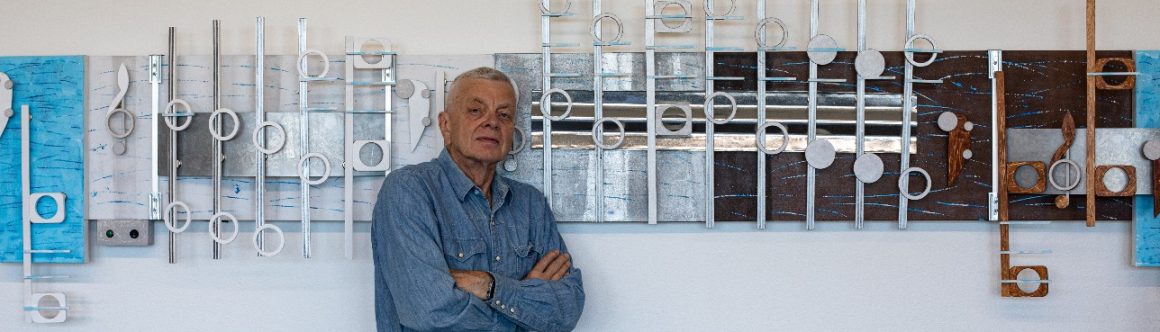
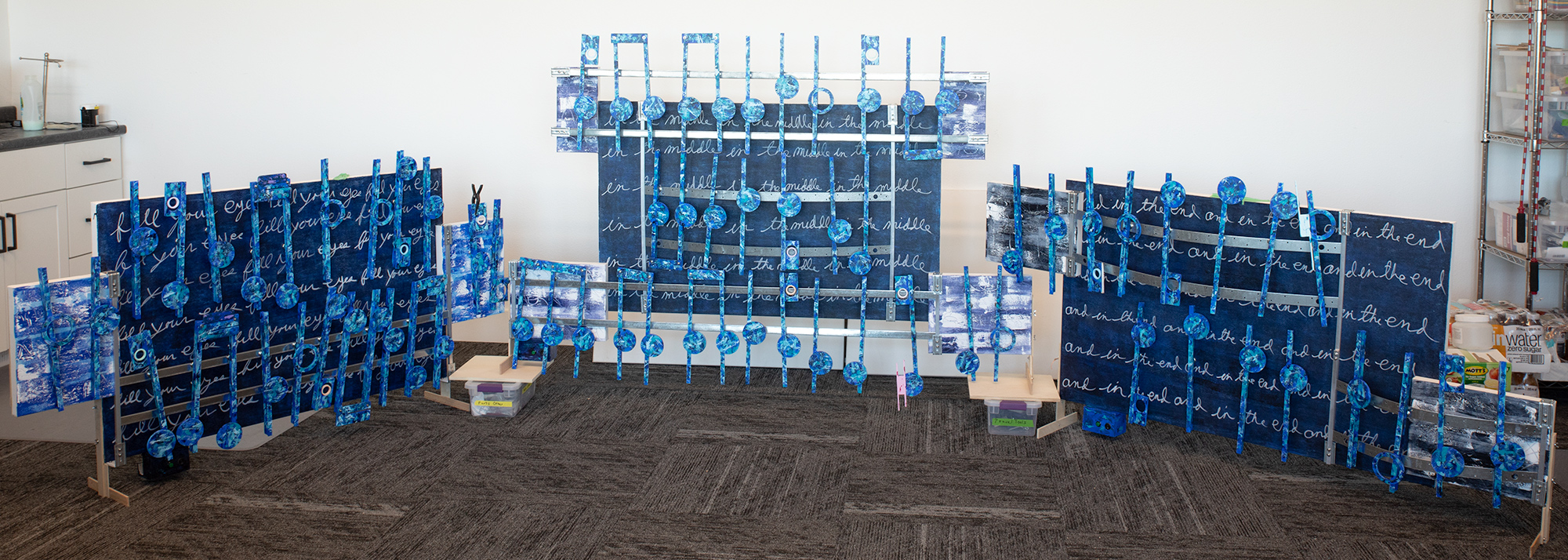
After completing the three artworks for this triptych I have spent the last few days assembling the cover music for the music box for each artwork. Each draft-length audio file turns out to be under one minute and fifteen seconds. I now think that this cover length will be my new audio limit. Previously, it was one minute thirty. That was the length of my patience and attention. Obviously, I am concerned with keeping viewers’ attention.
From 2006 on for many years, there was no audio option for any of my musical artworks. It wasn’t until I researched inexpensive sound systems that I found options and began experimenting with incorporating sound into projects. The first major artwork that I added sound to was The Turkish March in June 2018. I do not see any comments in that blog post about adding sound, which surprises me. I am guessing my general take on adding audio would have been to give the viewer a better understanding and a stronger connection with the artwork. No matter the why of adding audio, that artwork began my relational debate between the visual and the performance value of an artwork. That debate ended when I decided that my audio and visual production was of equal value. I believed I was creating two separate artworks: one that was visual, and another that was performance art. It was while working on this triptych that I changed my mind. I am returning to my original thinking that the performance art that is the audio is there as the hook to capture a minute and more of the viewer’s attention.
Ever since I started using sheet music and copyrighted material, I have felt insecure about that action. That is why, from the start of this art, I aimed to diminish the connection between what I was painting and its comparison to sheet music. I started with eliminating sheet music fundamentals: the staff, and any reference to the key, timing, or tempo. I believe that removing these references, and later eliminating other features, would make the artwork’s notation unplayable while keeping the up and down flow of the artwork’s notation.
Over time adding words from music lyrics added to the complications of copyright. Then, with the use of audio spreading from public domain music to copyright material, I realized I needed a solution to my use of what belongs to others. That is when I started purchasing cover licenses for audio by defining my artworks as music boxes. Each cover license is good for up to 25 music boxes. I only use one license for each song. To make this change official, I then simplified the description of this art genre from Interactive Constructive Sculpture to Music Box.
At this art start its fundamental foundational idea was to create a unique connection between a piece of music and an artwork. I wanted an artwork’s connection to a piece of music, to be more than just a title, colors, or style I found in previous artists’ musical compositions. Consider, one of many examples, the abstract artist Wassily Kandinsky. His art and philosophy contain many musical references with no connection to any single piece of music. The purpose and existence of this art is to take musical representation a step further by connecting the artworks’ notational up and down flow to a particular piece of music. I define this art as a portrait of a song.
The other significant change to this art was the development of a unique notation style. My current style of notation originated to fix a visual issue between a long narrow artwork and the up and down flow of the notation. I used this with the 2017 artwork, So What, but not again until the 2019 project Giant Steps. That is when I realized I had created a different type of notation. I now feel this eliminates any problems with sheet music copyright. My concerns then soon moved from the visual to the audio performance aspects of this artwork.
As for using audio I resolved this issue with the purchase of cover licenses. If there is no big money involved, I doubt anyone in the music industry would have had any major concerns about this art. In my eyes, though, it was about this art’s legitimacy and my use of other people’s art. The only contact I had over the years with the music industry where two minor word use issues on Etsy years ago. I have only a minor thought about my cover music in that to keep it music box short requires a lot of editing of the original music.
Bottom line, I am pushing ahead, following the wisdom of Alfred E. Neuman’s “What, me worry?” In some timeline this art will become well known. When it does, it will probably be up to unknown others to work out the details of its success. Until then, I see myself in my videos as the “unknown unknown artist.” This art for now is also that. Until it becomes well known, or sells at a level that becomes known to the public, I am going along for the ride. I know what helps to keep me moving ahead is another fundamental foundation of this art: it has never been about the money.
The following audio tracks are all in their draft stage. I built the audio for Golden and Carry using notation software. The audio for The End required a complicated drum track that I first attempted in the notation software but needed to move to my DAW (Digital Audio Workstation) software. StudioOne is where I finish my audio. It offers a wide range of production options and includes the add on software EZ drummer.
Scott Von Holzen
 aRT iN mUSIC