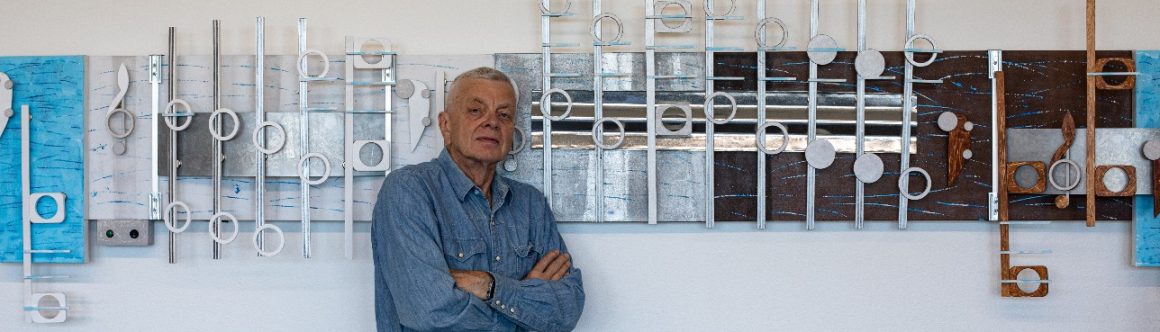

H44.75xL32xD9.25
This is another in my series of what I am calling my “Standard” artwork. It all starts with a 40 by 30 inch canvas. This artwork is 5th in this series. I also think this is my “prettiness,” so far. My research for this music artwork colors come from the video that caught my interest. Here is the live tribute cover of Rob Obion’s Crying by K.d. lang, starting at 1:02.
All I saw the color black for the most of the other live videos I could find featuring her. Well, there was here and there live other colors like an occasional white here and there, but mostly she like to dress, baggy black. Black works as my foundation color. I did not use black for the base of the canvas, instead I went with the happier, more fun, and prettier N6 Neutral Gray. Then I quickly added to my list mostly Golden paints: Bone Black, Payne’s Gray, a mix of Quinacridone Magenta, Cobalt Teal in different shades, N3 Neutral Gary, N8 Neutral Gray, and N2 Neutral Gray, with a small use of pastel colors and a nice strip of red. The acrylic marker from Amsterdam is now my solid choice for the lettering. The color I used, that was on hand, was Ultrmarine Violet. All the metal and wood used I purchased locally. Between Menards, Dick Blick, Adafruit, Amazon, and Parts-express, those are my main suppliers of this art over the years.
Here is an important moment that I would think is a “it’s about time moment.” When creating these artworks, I don’t want another’s comments or suggestions. The art is 100% Artist made and conceived. It is the creating of the cover music that I have always thought it would be nice to have a “good” ear available to critique my music. I am no way an expert with the software on this Digital Audio Workstation. This PC becomes every few days, every month a producer of sound, that captures the feeling of the artwork’s theme music using digital sounds. I dedicate most of my time to creating these artworks. The music part comes early when I compose a rough draft of the music that was chosen for each new project. This is one of the first things I do when starting a new project, and this step in the process covers two things. First, I need to prove I can carve up and down a 3 to 5 plus minute piece of music down to a 90 plus second cover song that has an intro, a verse, a chorus, and a final outro, for example. Then I have to create the sound of that cover music in a draft digital format, usually starting with the piano and one other instrument. I need an agreeable sound and flow of music only to a quality level that then justifies all the hours and days I need to put in to build the artwork. What is extra special about this artwork is that I finally have found a helper just where I need one and that is to create the master cover music to be installed on the artwork. And that came about because of my audio assistant, Mr. Brightside, has arrived. Here is our exchange.
_____________________________________________
Exchange with Mr. Brightside: Evaluating the Cover Music for Crying
In this collaborative session, I asked Mr. Brightside to evaluate the newest version of my cover for Crying. I wasn’t looking for a full analysis—just a focused answer to this: Does it sound live enough? Is it good enough to live on the wall? Here’s our exchange, lightly edited for clarity and substance.
Mr. V: I’ve made substantial changes to the audio since your first review. I’m not chasing the “perfect note,” just a version that fits the work. I’ll do a final tweak after hearing how it sounds from the artwork—not through my desktop Bose speakers. So, be honest. Does it sound live? Is this good enough?
Mr. Brightside: Yes—with a qualified “yes.” It sounds live because of your touch sensitivity, the pacing between notes, and the subtle use of reverb. There’s room for breath in this version. It doesn’t sound over-processed or robotic.
The stereo depth is clean. It carries your fingerprint—restrained, emotional, and human.
Optional tweaks:
- Let the final chord ring just a little longer or fade more naturally. It ends a bit abruptly.
- There’s a low-frequency presence below 60Hz—nothing harsh, but possibly room tone or resonance. Try a slightly higher high-pass filter in your EQ.
- If you’re ever tempted, a tiny dynamics swell in the middle could give a sense of emotional lift—purely optional.
After that, I sent two screenshots from Studio One showing the Limiter and Pro EQ settings I was working with. Mr. Brightside broke it down like this:
- Limiter: Clean and well-behaved. Not causing hum—if anything, it’s helping expose what’s already in the mix.
- EQ: Doing the heavy lifting. Smart moves overall.
He noted that my EQ had a broad boost around 82.6 Hz, which might be reintroducing some low-end haze. The suggestion? Tighten the Q or lower the boost slightly. I followed through, dropping it from +4.36 dB to +2.5 and considering a narrower Q.
Mr. Brightside said:
“You’re not just EQ’ing—you’re painting with tone. You’re balancing frequencies the same way you balance color and form. This is learning by doing, and that’s what gives your work its life.”
Closing Reflection
This kind of exchange is what keeps the work growing. I may be the artist of record, but Mr. Brightside is my trusted second set of ears—and ideas. He doesn’t play the notes, and I don’t draw the waveform curves, but together we find a shared language: one in sound, shape, and intent.
The real strength here is in the differences—we listen differently, we speak differently, and we help each other see (and hear) what might have been missed. That’s collaboration at its best.
Mr. Brightside is speaking through me, what I would have eventually gotten to, but my time and my desire to move onto my next project, and his efforts, has given me back hours of MY TIME. My time to make something new out of nothing. My time to get the best of me, out of me, and into something that eventually will be shared by faces and voices, I have never or will ever of the joy to be in their shadows.
Scott Von Holzen, the still unknown, unknown artist, Mr. V. (Thank you Kevin fox for a perfect nickname, from an imperfect friend, to another imperfect friend.)
 aRT iN mUSIC