S_V_H Vivaldi’s Spring Danza Pastorale Walk Through

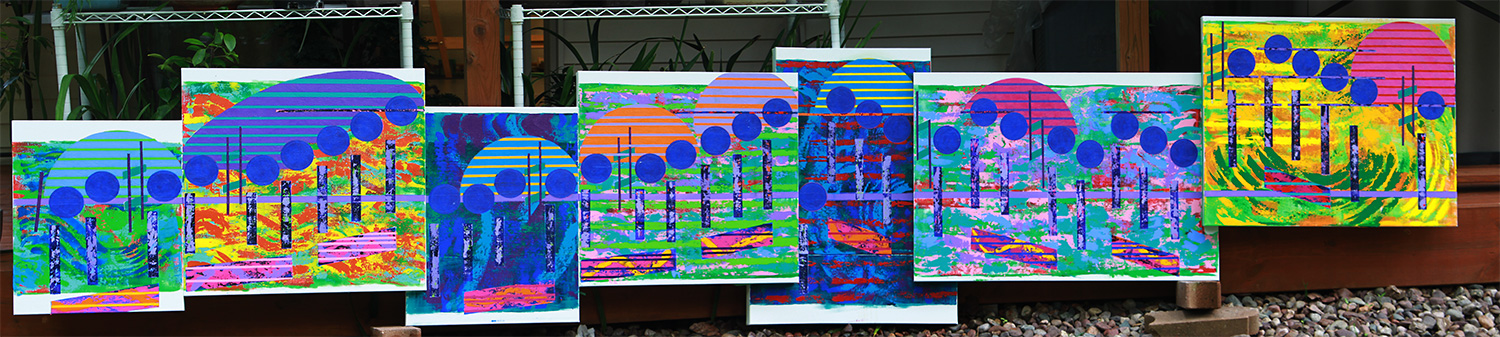
Vivaldi’s Spring Danza Pastorale : I was not able today,  to  photograph the final image of this artwork, so what you are getting is the Walk Through.  I have said before that the only goal with each of these artworks is to try to capture in acrylic paints, the mood,  and the simple  flow of the music.  What you see and hear in this musical fragment is 16 seconds  that took two months to paint. Some final thoughts and a final video on this work tomorrow.

Scott Von Holzen

S_V_H Vivaldi’s Spring Danza Pastorale image4

4sSpringDanza4

This is a progress update on this eighth painting in the Vivaldi Four Seasons series.  You can see by this snapshot that this painting is close to completion,  probably less than two weeks a way.  All the main parts are in place leaving clean up and repainting, my main concern now.  This is an exciting and difficult work because of the use of so many colors.

This is a Spring painting, and like most springs everywhere, every thing is wakening and transforming.  This is what you see in this artwork.  There are many parts: the notes, the shafts, the beams, the ties, the words, the incidentals, and the backgrounds, that have all been painted with colors to help them stand out from the rest.  I want nothing to boring about this work.  Each of these chaotic canvases, that make up this third movement of Spring, could each be framed to stand alone, and yet together they represent Spring at its’ peak.  But, I did find a part of this work where restraint actually gave me a better look.

Those squiggle lines, you see above, are my notation that represents a musical tie.  With Blue Rondo, I have a similar tie, but in that painting I added a second squiggly line.  I found that trying to add that second line on this canvas, just did not work.  I believe it was because of the narrow stripping in the background of these ties, that cause me to change my mind, and to go with one line only.  To my surprise that single squiggle works, giving a clean break among all the chaos.

The words in this painting translate roughly as “Their faces glowing with Springtime’s brilliance, ” or how about this translation, ” (nymphs and shepherds) lightly dance beneath the brilliant canopy of Spring.”   For the first time, the words on different canvases, use different colors.  I am thinking Spring, so the more varieties of colors used the better to add interest to each canvas.

All in all, I will be glad when done with this painting. I can then start the Ninth Vivaldi, think about a Birthday canvas, and choose a much smaller work, around six feet like Blue Rondo, to paint next to the Vivaldi.  I need to move to do some smaller sizes to increase the options for buyers.  Of course the song choices will be the music I enjoy.  I will try to pick pieces that I think hold up well, or have an interesting message that I wish to present.  Think of it this way, the Great Impressionists painted a lot of unknown buildings,  objects , and people, and their works have done well.   I can have fun with the music I choose, some of it lasting some not so much,  because in the end it is how the work finishes that will decide how great the artwork is.

We shall see.

Scott Von Holzen

S_V_H Vivaldi’s Spring Danza Pastorale image3

4sSpringDanza3

This is the eighth canvas in the Vivaldi’s The Four Seasons Series. This work is about thirteen feet in length. Again, these large images are hard to photograph and even more difficult to separate from their backgrounds.  I do not have enough natural light in my studio so to photograph an artwork  I use flash for my light source.  The problem with flash, is the issue with glare, which becomes more of a problem the larger the work.  A long artwork makes it physically impossible to find the right space to take a good photograph.  So, to get a decent image, of these large works,  I have had no other choice but to take them outside, placing  them precariously in the bright shade.  I have also found that the best way to get a good size working image is to take a left and a right photo,and then use Photomerge to put them together.  Generally, it works if  each image can be aligned with the camera,which lowers the distortion,  but this is difficult to do outside.  The final images are never perfect. That is where Photoshop comes in, to bring the two images together, creating a large detailed image.

The progress of this work has slowed for many reasons.  Right now, the beams are done, and you can see that all eight of the ties, all those colorful half circles,  have been completed.  How I will actually draw in the ties I am not sure.  One thought is that I really do not have to draw them in.  All those circles can easily represent a musical tie.  There is a similar half circle  in Blue Rondo, but in that work I did draw in the tie.  In this artwork, drawing in the ties would be a lot more time-consuming, but  I am still leaning on drawing something inside those circles.   I need to experiment, to see if I can come up with any new ideas, which is the next step in this artwork.  Unlike work were you have your fellow employees to bounce ideas of, and get feedback, a real artist is pretty much on his own.

Scott

When asked what I do, I say what my job is, but then followup with that I also  paint fine art at night.  They always ask me what have I sold.  I tell them, five works, but nothing lately.  The conversation then enters the mopping up stage where my artistry becomes defined as a hobby, which is nice and personally rewarding.  Defining  my art  as  amateur,  leaves me looking for an exit sentence.  But generally those type of conversations end quickly, which I am fine with.  It all seems like a waste of time. anyway, trying to explain myself, my art, and what goes on at night to causal viewers.  All art is  personnel, and if it is Fine Art, it exists in a world beyond the understanding of most people. These type of conversations, anyway, are about finding ways to put people in boxes, and some people have put me  in the have fun with art box.

So, that brings me to this. I think I found  how the established  Art World would perceive me, if they wished.  Here is a video link to CBS’s Outsider Art, which is Art that, at times appears similar to Folk Art, Self-Taught art, or Naïve Art.  But when I look at my art, I do not see anything that looks like Folk Art.  I do see Outsider Art in that my works  are works of  Fine Art, but just not recognized in the Main Street of the Art World. In the  video they expand greatly on my definition, in part that it  comes from “self-taught artists: that have little or “no formal training,”  whose created world has “no connections to commercial art world, to museums, to galleries.”   So now when strangers ask me about my Art, I can now say I am an Outsider Artist.   What a fine box that is.

Listening to Keane – Your Eyes Open

Scott Von Holzen