S_V_H After the Gold Rush and print offers

The melody, After the Gold Rush, is a classic rock project from the music of Neil Young.   The lyrics tell a disjointed (poetic?) story I find hard to follow. Although the meaning of the words are cloudy , the strength of the melody pulls the song together. This style of this music is country/folk rock ‘n’ roll, with a touch of Gospel.   The results are lyrics that are haunting, although I don’t know why.  For example “Thinkin’ about what a friend had said, I was hopin’ it was a lie” and “All in a dream, all in a dream, and I was lyin’ in a burned out basement ,” which makes no sense to me, but sounds intriguing.  Finally, maybe it is an environment warning, as suggested by others, “Look at mother nature on the run in the nineteen seventies/twentieth century/twenty-first”…..”Flyin’ mother nature’s silver seed, To a new home in the sun.”

Here is a live version from 1993:

Each new project’s preparations start with picking out a piece of music to paint. I do not have a set system that picks the music. Many times it is hearing a song that reflects my current mood or enthusiasm. For example, if I think it’s time to create a Mozart project, I would listen to Mozart until I found a phrase, or a section of music that I thought was catchy and that had a good start and ending point. I would then search for the sheet music to see the flow of the music. If I found the movement of the music interesting, I would then put together different canvas options, before making my final decision. That standard procedure worked for many years until I started creating my own arrangements of the music. My focus now becomes the entire piece of music.

Today, my project path starts with first writing my sheet music arrangement of the music and then figuring out how to apply it to canvas. The final decision is hard, for to proceed can easily consume a month and more of my time. Only then does the physical part of building the artwork begin. For this next project, After the Gold Rush, I have already written a basic one-minute piano arrangement. The next days I will spend making improvements to my melody and the flow of the artwork, before starting production.

_________________________________________________________

I have upgraded both of my print sales sites to offer over 170 Artworks from 2006 through 2020. For the last couple of years, I have focused all my time on moving from one project to the next. This resulted in little updating of my print sales sites. After finishing this year’s last Christmas artwork, I used the next couple of weeks updating not only my print sales sites but also my main website.
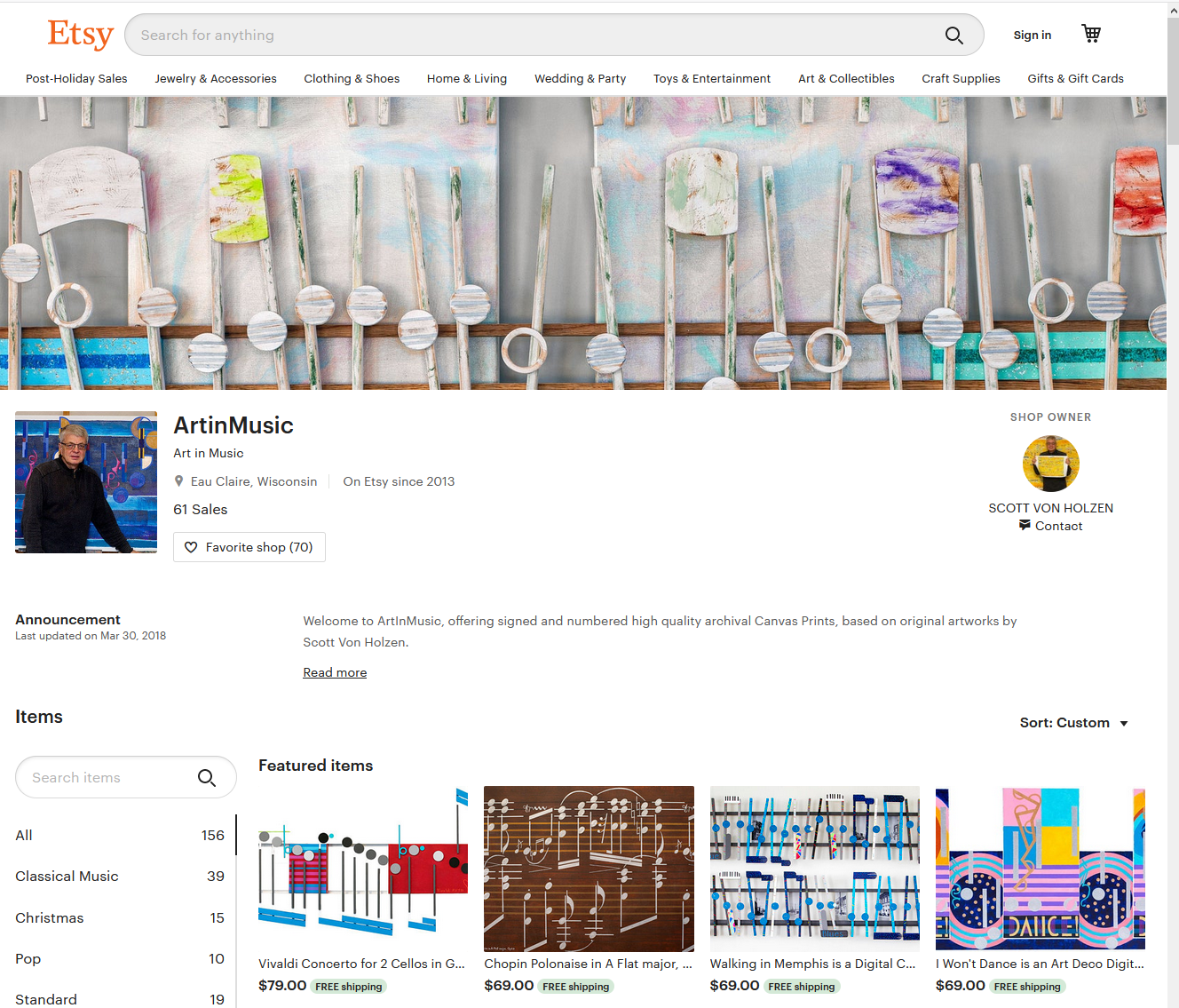
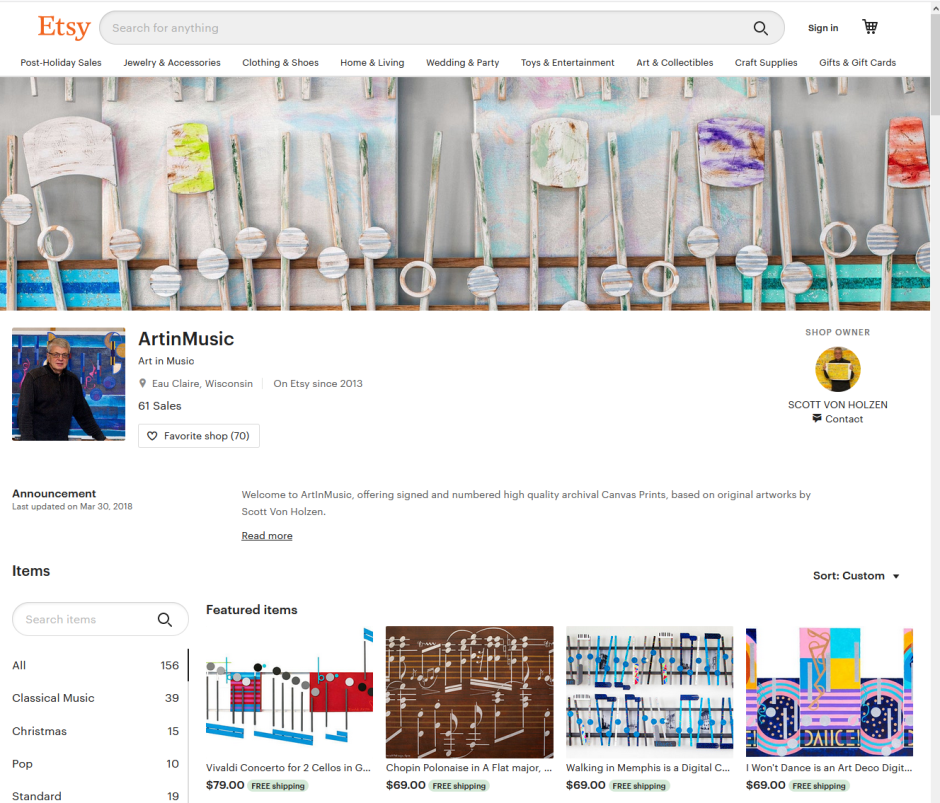
I am offering on my Etsy Print Store a $10.00 off coupon through February along with free shipping (USA only) for any of my prints. At checkout, apply the coupon code, blog10. This coupon may work outside the United States but without the free shipping option.  For my Amazon site, I will offer individual item discounts, which is more complicated to set up than Etsy. Discounts on Amazon are coming in time.
My Etsy and Amazon prints sales sites have sold prints consistently and have provided a small amount of net income over the years.  What they have not done, along with my main website, is to create any buyer’s interest. In comparison, the many public exhibitions I have applied and showed in over the years, have also created no buyer’s interest and have fallen far short on covering expenses. With all that in mind, I have now decided to no longer register for any group exhibitions (all those that require admission fees). To keep this art on public view, I am increasing my efforts to improve my sales with my two prints sales sites that actually provide a small income. That then brings me to my last Etsy store: ArtInMusicPaintings, that I created to sell the original artworks.

This second Etsy store I created in 2013 to sell the artworks. Right now I have put that store on vacation for all of my artworks are currently in storage that allows no access.   Since its founding, this site has sold 14 artworks with the last being December 2017.   My ability to market these original works through Etsy has changed over the years. 

The price of shipping a large box has increased over the years as UPS changed their pricing based not on weight so much as size.   Etsy pushes hard for all of its stores to offer free shipping, but that does not work with most of my artworks that are over four feet in length. These artworks are large and lately they have grown even more fragile to handle, which makes shipping safely nearly impossible without a considerable amount of expense. Besides some packaged artworks would be over the UPS dimensions limits and then would have to go by freight.   The current Etsy push and store marketing support is focused on free shipping. Trying to sell higher valued artworks on Etsy with free shipping would require me to increase artwork prices considerably for who knows where in the USA an artwork would have to be delivered to. I do not have to offer free shipping, but I cannot help but think if I would keep this store on Etsy I would still try to keep shipping under one hundred dollars, raise artwork prices another one hundred, and eat the difference in shipping cost where needed. I have reached the point that I do not want to deal with shipping artworks. That leaves me almost without options to sell.

Here is the Etsy link

Scott Von Holzen
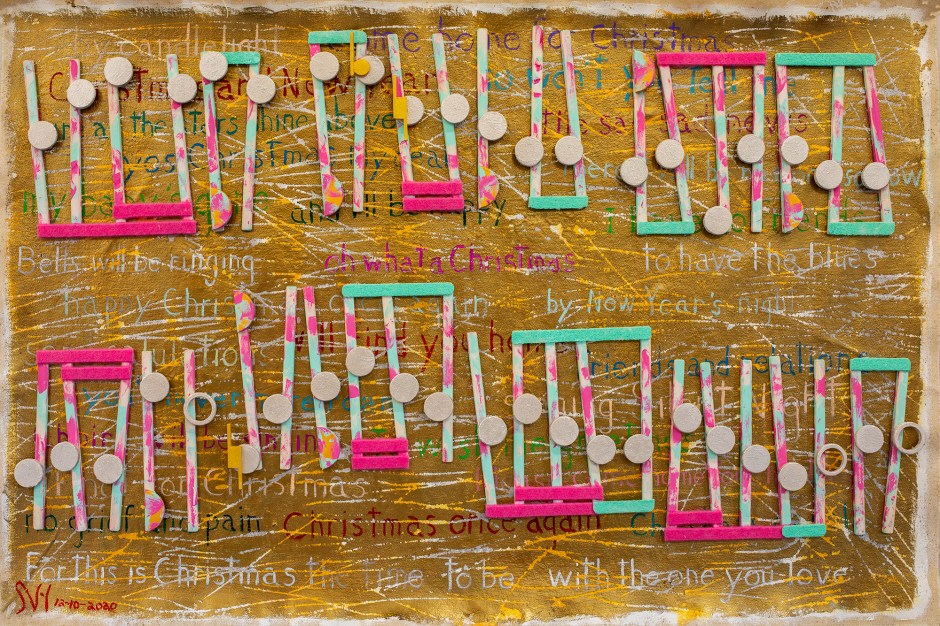
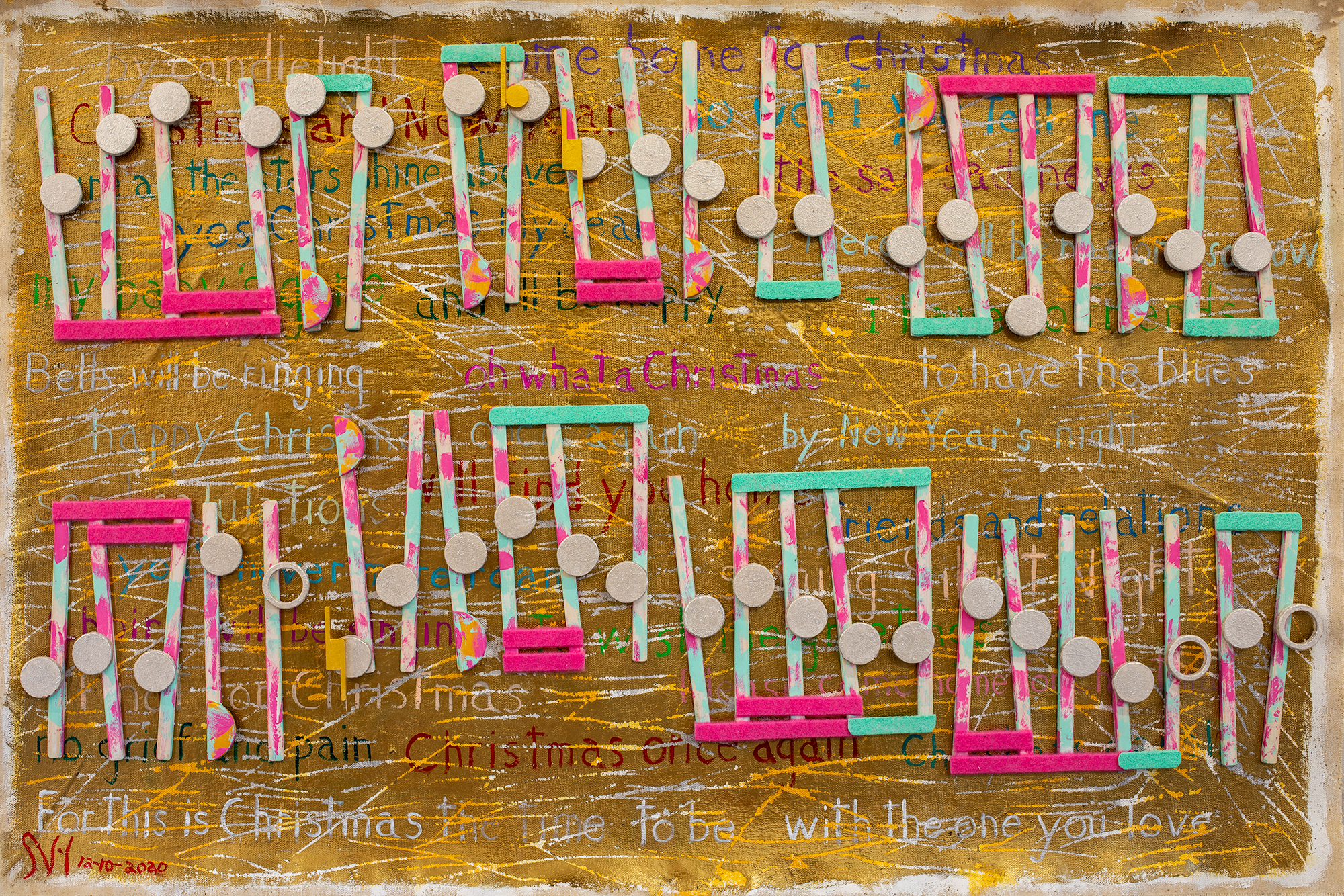
S_V_H Please Come Home for Christmas_ project complete

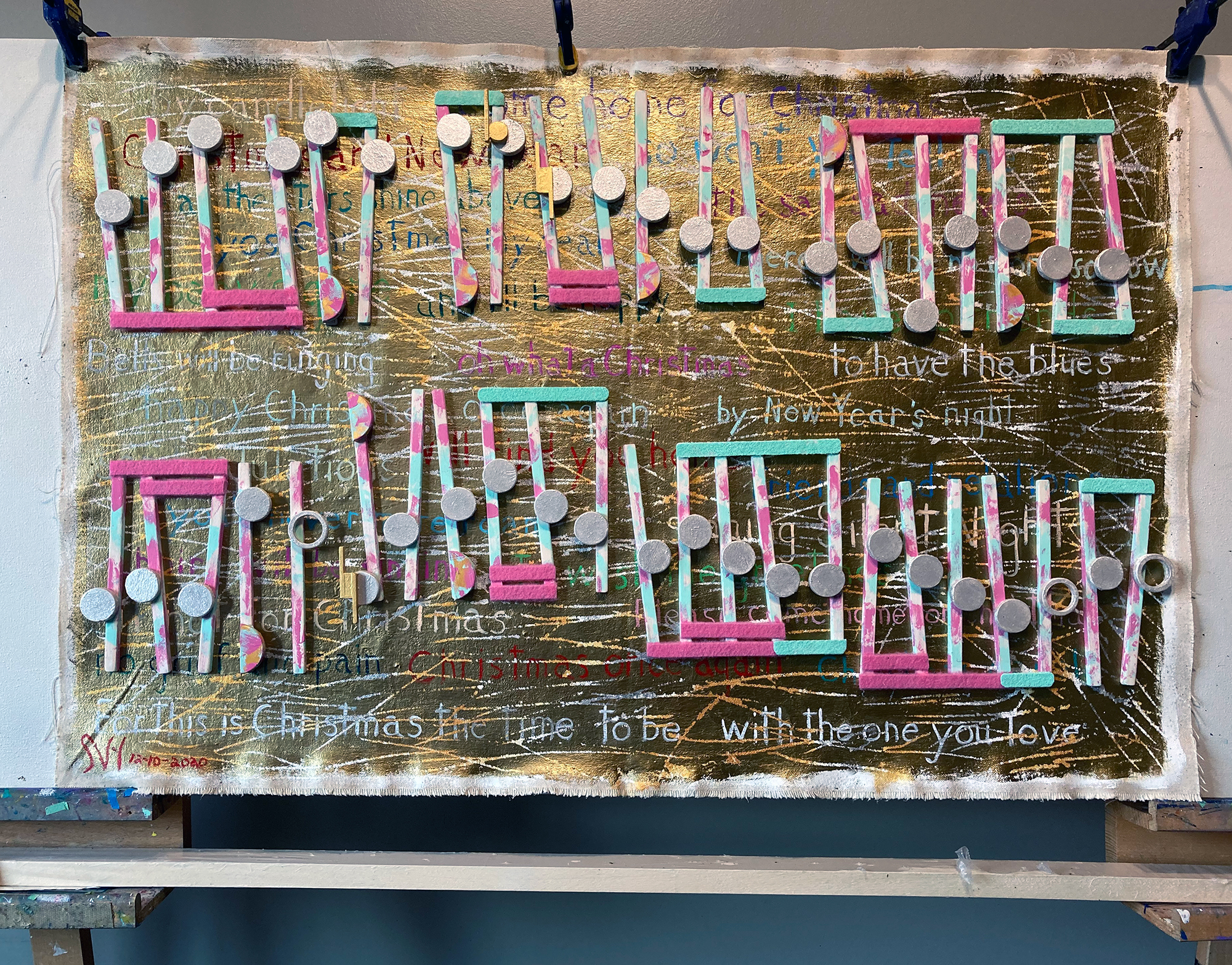
My approach to creating a Christmas painting for the last fourteen years was to keep it simple, in the current style of that year, and get it done quickly and painless.    That all ended with this the last Christmas painting. 


My explanation starts with my previous blog entry: ” … I found this music…….. going through several video lists of the top Christmas songs of all time.    ….. I stopped to look at a video of a song I never heard of called Please Come Home for Christmas.  It was being sung by Bon Jovi….. …… The cover that closed the deal was by the country singer Martina McBride.”  That was my typical start of a Christmas painting.  What happened next requires a brief history retelling.

It was in 2018 that I noticed that the amount of music I wanted to base my portraits was increasing in length.   Eventually, I stop using small pieces or short phrases of music from sheet music.  That had been the norm since the beginning of this art.   This happened because I was creating my own arrangements as I added sound to an increasing number of artworks.   As my arrangements and the sound reproduction improved, so did the length and the size of the artwork’s music.   The switching to more professional software improved the quality of my arrangements even more.  This all sped up, with the decision to buy a mechanical license for any copyrighted music I wanted to portray.  This trend to expand the artwork’s arrangements surely had its origins from Classical and older pieces of musical artworks that were in the Public Doman with no copyright issues.

Now that I had the Christmas song I wanted to portray, as in the past, I needed a short piece of the music to do an easy and quick to finish artwork similar to the last fourteen years.  I wanted the music to fit on a three-foot by two-foot piece of primed canvas.   My problems started with the song’s arrangement, which required a lot of time and effort to complete before I could plan out the artwork.   I soon realized it was going to be difficult if not impossible to fit my arrangement of Please Come Home on my chosen piece of canvas?   To fit a minute plus long arrangement of music on a 3 x 2-foot canvas would require a ridiculous reduction in the wood’s size to fit three lines of music across the canvas.  The arrangement contained almost a hundred pieces of the music, which would require weeks more work to create and finish and a larger piece of canvas.   That seemed like an exhausting and crazy waste of effort and time for an artwork I basically felt indifference towards.   Christmas time restraints were already becoming a concerned.  When I realized I could not fit on a small canvas, an arrangement that used up days of effort to create, I changed direction.

I decided I would eliminate a fundamental rule that I lived with from the first music painting.  What resulted was that I reversed the roles of the Artwork and the Music.  From day one of the art, the chosen music had to match the flow of the artwork’s design, meaning both the artwork and the music needed to fit the canvas.   That changed with Please Come home.   Please Come Home became the first artwork to no longer be a portrait of a song.

The arrangement of the Music for Please Come Home now became the source material for the Artwork.   For this project, the plan was to use a small size canvas,   That made it impossible to display all the music from the arrangement.   For the workaround Please Come Home became the first artwork to sample the arrangement of the music.   What the means is this artwork would not be a portrait.  Instead, this artwork would be a sketch of the music. 

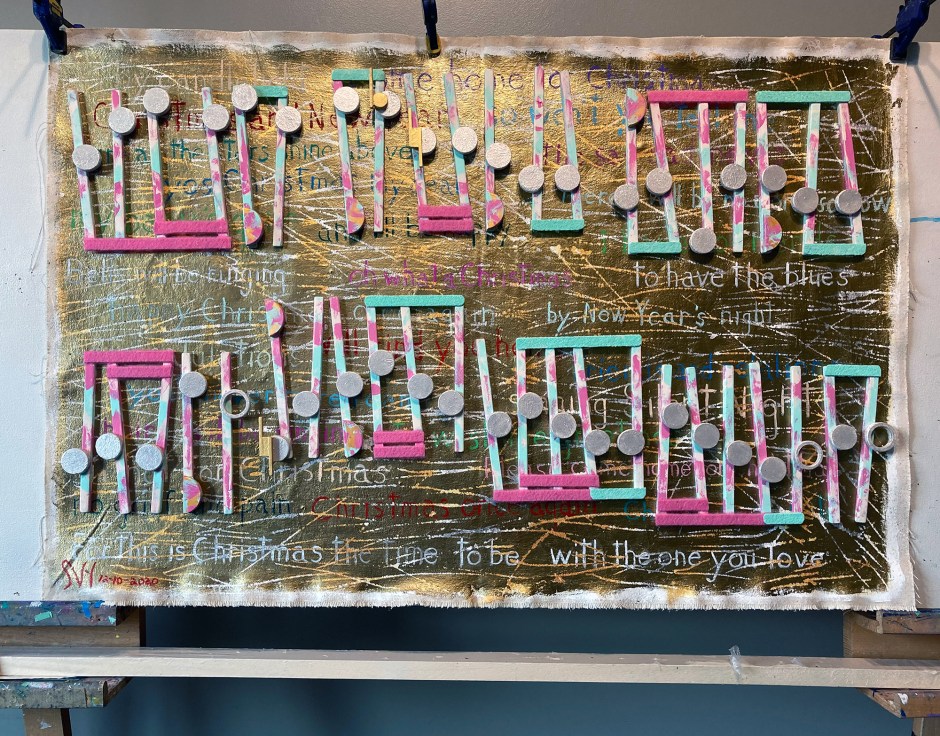
Sampling defined by Wikipedia is “…. the reuse of a portion (or sample) of a sound recording in another recording.”   In Please Come home for Christmas, I am displaying samples of the musical arrangement in two lines across a three-foot canvas.   I took the words from each sample of the arrangement and painted them where I planned to attach each wooden sample.  I then painted the other words from the music in no particular plan or arrangement to liven up the interest and for their connection to the music.


I have these other thoughts on this final Christmas painting and the final artwork of 2020. When a viewer looks at this artwork, what are they looking at I ask?  I have wondered and debated this question with myself throughout this year.  I going to guess because it is fictitious that anyone has looked in person at my artworks and told me directly what they were seeing, or lately hearing. 

I can see the total disruption of sheet music being transformed into the visual as a portrait that is a mix of two abstractions: music, and the visual arts.  This can be a blending into a new form of art?  I could also see a future for painted sheet music of popular music.  Or maybe there is nothing to see here.   What if I don’t really listen to music and if I did I surely would not understand what music looks like, or even care to know what it should look like, but I am guessing it doesn’t look like what I see in this art, and so all I can say is, whatever and where is that button so I can at less have a moment of enjoyment playing the sound of something that means nothing to me?   It is all a not sure.

What I can believe for certain is this art is moving to sampling.   I feel I am stepping through another unlocked door that leads me from what was to what is a path where music and art are one: Art in Music.

Scott Von Holzen


S_V_H Please Come Home for Christmas progress images

Background canvas layer image

Please Come Home for Christmas is this year’s Christmas painting and the last in the series.  This first image shows what I would call a generic abstraction.   All I am trying to do is paint the canvas with colors that when scratching off the top coat of paint would review a contrast in color interest between the two layers.  It is a style of painting that I can honestly call my own.   Concerning the painting of the background, I noticed after scratching down to the background that I should have painted over all the white areas of the background.   I believe that would have improved the color contrast with the top layer paint.

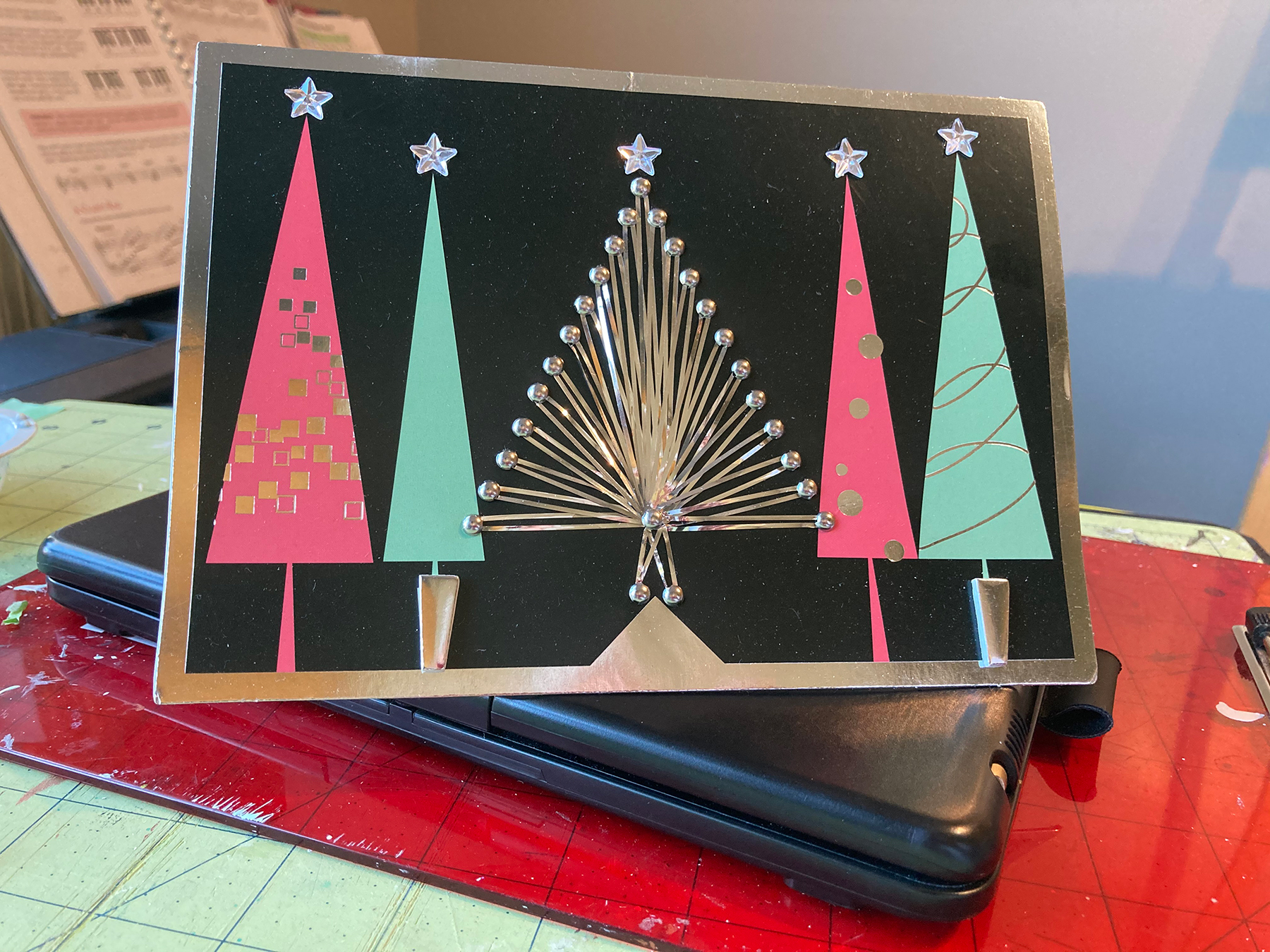
My brother Roger’s Christmas card gave me the basic color scheme for Please Come Home.

I was hesitating to paint another Christmas painting.   This conflict has been growing for years.   The feedback over the last 14 years has been almost nothing. The original reason I spent an enormous amount of time and effort to create an artwork and then design, produce and send out Christmas cards was a way to say thank you by staying connected to those who had purchased an artwork, or people and friends that have supported this art.   The issue became this plan never grew. Everything remained as it was from the first Christmas card to last year’s fourteen versions.  It became a yearly habit and nothing more.   The creating of fourteen Christmas paintings added up to a lot of time spent that resulted in a few responses, and not a single artwork or print sale.   The reason today that I am creating the fifteen Christmas painting came from a comment I got from one long time Christmas card receiver.   She had made a custom framed for all the canvas prints from the Christmas cards and had one last blank space left to fill.  I guess it came down to this, which was enough to continue this series one last year.

When I first introduce my choice for this year’s Christmas artwork, anyone who looked at the videos could see this was a distinctive agnostic style of a Christmas song that I was looking for.   How I found this music started with going through several video lists of the top Christmas songs of all time.   At first, all the music that appealed to me I had already painted.   That forced me to go back through the list that I thought contained the most diverse songs.  That is when I stopped to look at a video of a song I never heard of called Please Come Home for Christmas.  It was being sung by Bon Jovi and included the delightful Cindy Crawford.  This caught my interest, to watch other videos of Please Come Home.  The cover that closed the deal was by the country singer Martina McBride.

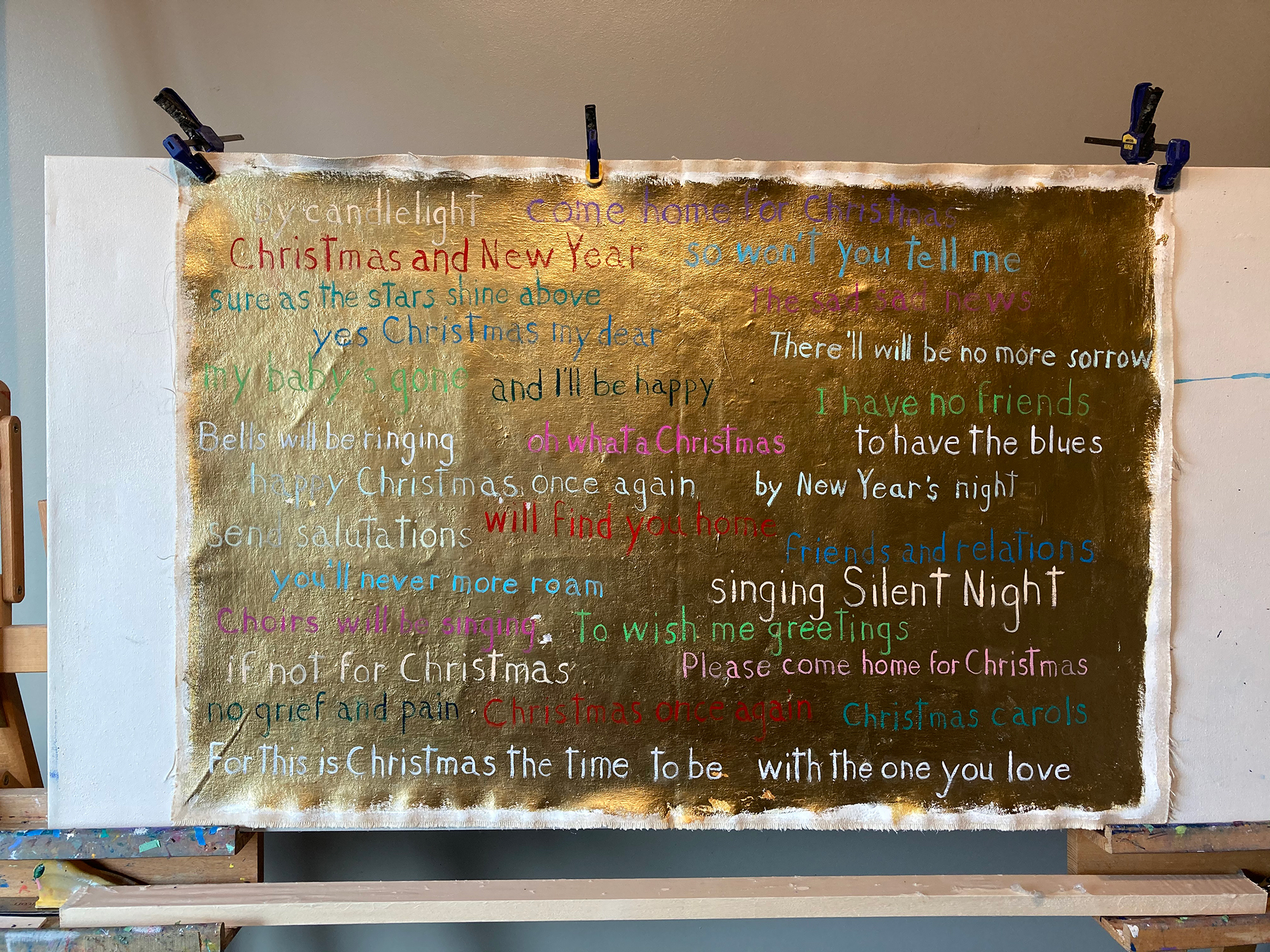
top paint layer covering up the background image shown above

The finished top layer of acrylic paint includes many of the words from the music.  The addition of words to an artwork helps connect the music to the artwork and provides the opportunity for the words to have other meanings beyond being the music’s lyrics.   I took the pieces and phrases of the lyrics and placed them where they would fit without concern for their order.  I kept everything fairly horizontal and used different colors for each group of words for separation and legibility. 

In the past, I have waited no longer than a day to begin the scraping process.  For this artwork, two days passed before I took a narrow pallet knife and scraped away the top layer of the artwork to review the background.  I noticed that the scraping was harder to do.  Probably because of the extra one day delay. 

I made sure my scratching away of the topcoat was extensive, even across the words, to bring out the contrasting background colors.  What surprised me when done was how easy it was to still read the words. Unlike the previous artwork, Woodstock, the scratching off of the top layer only then revealed the words. 

This is the finished canvas image part of this project.

This last image is a snapshot image of the signed canvas image of this year’s Christmas painting.   I used a stiff felt material for the pink and green-colored rectangles (my musical beams, ties, and slurs). The pink color is that of the felt, while the green color I painted using another piece that was white.   Knowing I would not be stretching this artwork, I went with the use of the flexible felt being attached to the mounted wood.  Felt bends, unlike wood.   This then would lessen the chances of pressure on the glued wood if there was any twisting of the canvas when being moved.

This finishes the first part of the project.  In the past, this step would be the end.   This artwork requires that I build a wall mounting aluminum frame to attach the canvas too.  I will next construct the speaker boxes and solder together the stereo system.  The installation of the music that I had arranged before even starting the work on the canvas is next.   I then attach everything to the frame to finish the project.  The result will be an artwork that will wall hang with a button that when pressed will play the musical arrangement that the artwork is portraying.

Scott Von Holzen