
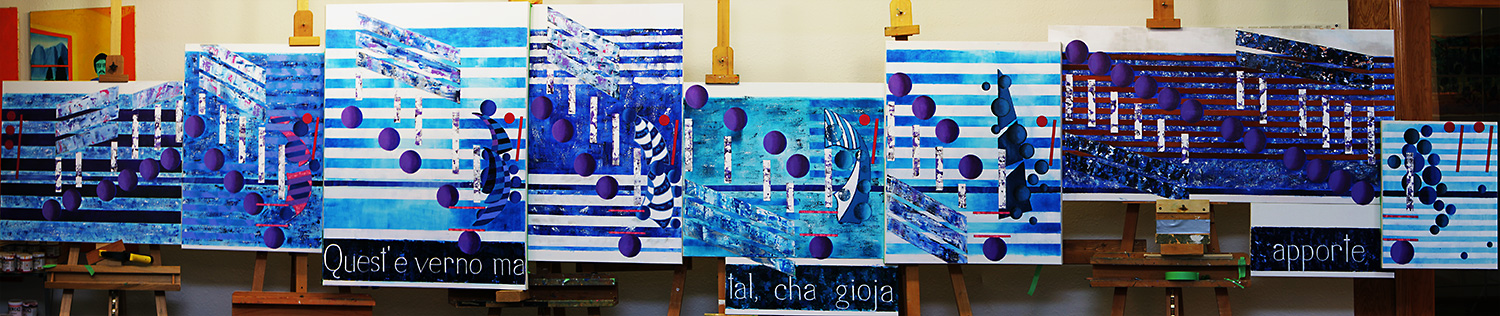
This Vivaldi work consists of eight canvases stretching just over thirteen feet (3.96m) and overall some 32 inches in height. This size artwork, small in comparison to Winters Allegro, still requires a sixth easel to stabilize the work. This tells me I need to add another easel to both sides.
This is a good working size that better fits the dimensions of the painting room and this house. Another advantage in this smaller size is that the largest canvas used is only 30 by 36 inches (1m), which means that this work does not need large amounts of paint to cover the surfaces. This allows more experimentation at a lesser cost when mistakes need covering up. Of course, if this work would have required bigger canvases, it would have been larger. The length of an a new artwork comes form the musical phrase chosen, and the size of the music, which in the Vivaldi series has been at less 80 mm in diameter.
I cannot think that six months ago I would have accepted what I am doing with this canvas. What has changed, is my use of a squeegee to apply multiple colors, after painting the background. Across different parts and layers of these canvases, I am using multiple sizes of the squeegee , unlike Winter Allegro, where I first used a squeegee, but only on the beams.
When I started painting, the thought of only using paint brushes felt like a limitation to me. I knew then that I had to find and use different methods of applying paint. I quickly started to use 2 and 3 inch rollers and I found larger 2 and 3 inch brushes to spread the paint about. I even tried plaster brushes and even a small amount of dripping . I then started to use different sized pallet knives, some custom cut to size, to spread the paint across the canvas. But I found that the pallet knives created unevenness on the canvas surface, that was fine for the background, but looked unsightly when applying the musical flow. My only solution then was to scrap the paint down to smooth out the look for the music flow. I soon decided that pallet knives where not the answer. I went back to using proven brushing techniques, using only small pallet knives on the shafts of the music, and dropping rollers completely.
It was seeing a documentary about Gerhart Richter, and his use of a L shaped homemade squeegee, to spread his paint that I saw an opportunity. Richter, appears to me, to use slower drying oil paints, that he would spread across the full length of his squeegee. This allows him to later to apply more paint that would then mix in, or scrap away layers revealing what was under the surface. I decided to designed and built my squeegee.
Since I am using acrylics, that dry fast, I needed to find a different technique to apply the paint. What I first do is apply thin strips of paint on the squeegee. This allows me to keep part of the squeegee clean, which prevents the bottom layers from totally disappearing. When dry, I can then add more layers of different colors, spread on only parts of the squeegee. Each time I draw it slowly across the canvas, watching and changing how the squeegee interacts with the paint. This application technique leaves flat layers, for the most part, unlike rough uneven surface I was getting with pallet knives.
If you look back on the Vivaldi series you can see how I have evolved the backgrounds to have more of an interaction and effect on the music. The flow of music remains the strength of these works, but from the beginnings of this art I have struggle to understand what the purpose of the background is in these artworks, besides adding contrast and covering the white surface, for the music flow.
What I am seeing now is an opportunity to represent in the background, not only as decoration, but as the bass of the music like the music flow represents the soprano of the music. Constructing the background to represent the look and feel of the music’s bass is an interesting idea, that needs more thought. We shall see what may evolve out as this idea, as this art keeps moving forward.
Scott Von Holzen

 aRT iN mUSIC