S_V_H Vivaldi’s “The Four Seasons – Summer-adagio” image1

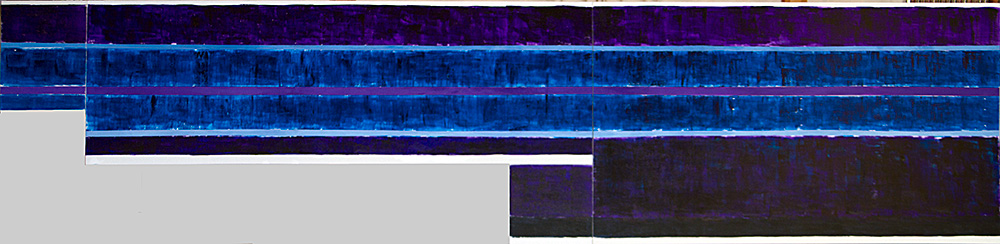
Vivaldi’s The Four Seasons four Canvas, 12 feet(3.66m)in length by 36 inches(.91m).  This is a snap shot, of the early background.  Next up will be to draw in the music to see how it lays across the canvas. Once the draft of the music is laid out then it will be back to the background.

The grey colored area, on the left side of this image, is not canvas. What you are looking at is the first odd shape work, that  could be called a combine.  To explain how this art got to this point you have to look back to 2005.  From one canvas to another,  it was felt back then, that it was necessary that the musical phrase  fit the selected canvas support.  Of course that was restrictive, which eventually lead from works that were on a two foot by four canvases to larger signal sizes and then to works on two same size canvases bolted together in 2009.

It was in earlier 2012, with the Mozart work Serenade No.13, that this artist realized that this thinking was backwards: the art needed  to accommodate the music.  That is why you see, in the image above, that extra 12-inch panel on the far left, and the 12-inch panel in the lower middle.  Those two small pieces will allowed  the bass sound a stronger visual on the right side. There are style changes in the sharpening of the effort to  not  blend the canvas parts together, and with the use of two different size canvases, that are awkward to handle, that compose the background.

One thing that has matured with this art, over the years, is the approach to depicting music. If you look at general sheet music, it is rigid in structured and this set the standard for much of my earlier works.  But that got boring, and once the technical confidence grew, so did the ideas to better paint the flow of music without turning it into a typical wall hanging.  This art is not your generic abstract  music painting, splashed in complementary colors, you see everywhere. This art has grown and so have I while staying true to the idea that started it all.

Listening to:   The Thrill is Gone – B.B King,  Hallelujah – K.D Lang,   The Bee Gees – Stayin’ Alive,  She Talks to Angels – The Black Crowes, Peal Jam – Come Back.  George Carlin – Capital Punishment

The following is a video of this music:

UPDATE on the Birthday Painting Suggestions that have come in.  Here is the list so far:

Unchained Melody – The Righteous Brothers.

Your Are so Beautiful – Joe Cocker

Roses are Red  –  Bobby Vinton

I Will Always Love You – Whitney Houston

House of the Rising Sun – The Animals

Blame it on the Rain –  Milli Vanilli

Vincent – Don McLean

What’s Going on – Marvin Gaye

Changes – Tupac  Shakur

The Sky is Crying – Stevie Ray Vaughan

 It is your turn  to add to this list. Here is the link for the details, detailing the Birthday music painting.  On my Birthday, July 31st I will start,  and complete this work.

Scott Von Holzen
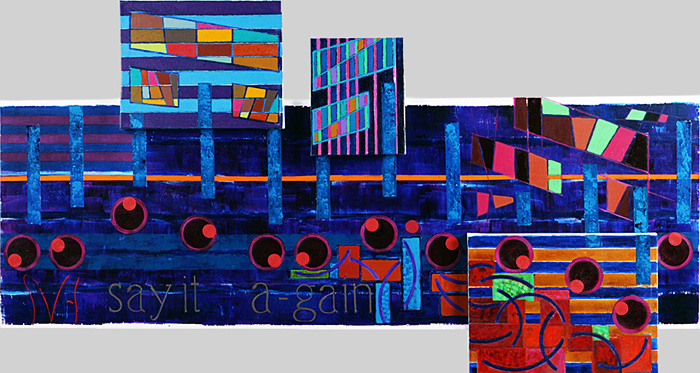
S_V_H Vivaldi’s “The Four Seasons(Autumn)adagio molto Final image

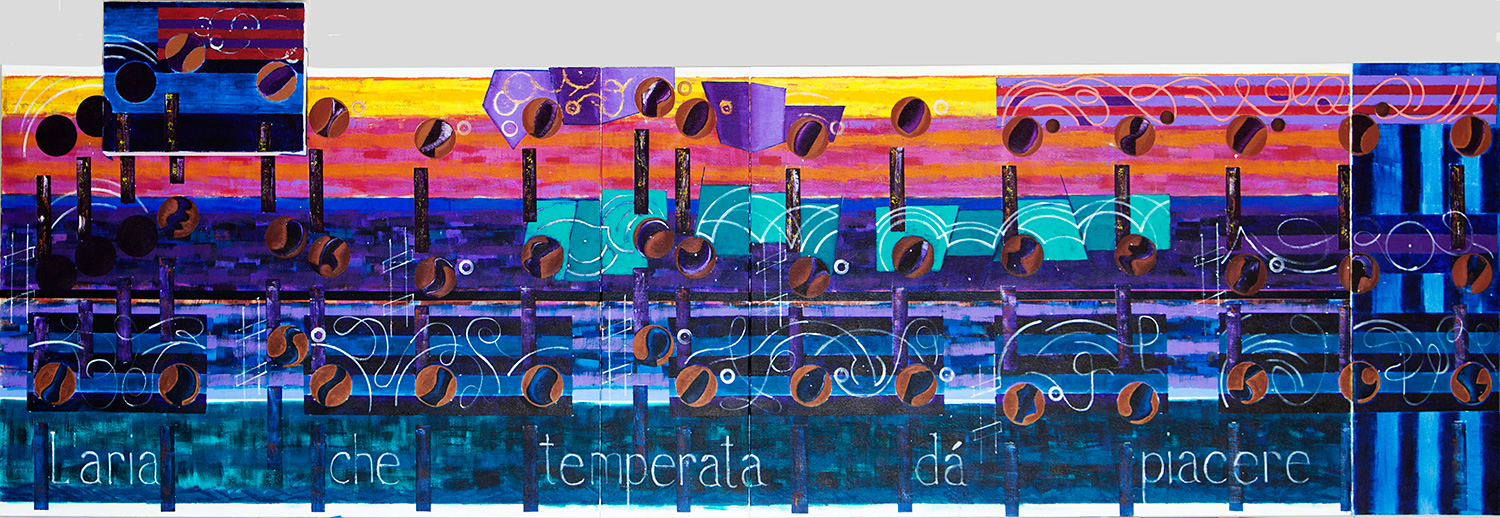
Vivaldi’s The Four Seasons – Autumn – 2nd  movement.  This artwork is composed of five canvas panels with a total length of 120inches by 40.75 inches, maximum height.  This work was started on May 28th and now 47 days later it is finished. The guesstimate is a minimum of 3 hours a day was spent working with this artwork.  This means about 130 hours to complete.  The amount of time an artist puts into a work is not a prerequisite for value or quality, but it is good information to have when planning.

Listening to One Night in Bangkok

Melissa Ferrick – Don’t Say Goodbye

Bruce Springsteen – Streets of Philadelphia

Etta James – At Last

If I look at this painting objectively, there is not much in art history that looks  similar to this, or that approaches the way this art depicts music.   That does not mean it is any good, but there is a feeling, that this new Vivaldi work is continuing the push of this art in an interesting direction.

What then was accomplished with this artwork? We can start with those interestingly portrayed musical ties that are crazy good in this work.  This is an image of your standard sheet music musical Tie:

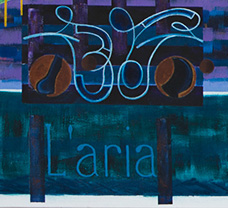
Now, here is this artist take on a musical tie from this painting:

There is no comparison, one image is of standard musical notation, and the other has nothing to do with music and is a creation from imagination. Simply put, one can be played, while the other can be either appreciated or dismissed.

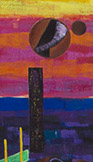
This artist take, on Vivaldi’s musical notes, took on the look of  individual planets (not intentionally) each with their own little moon (dotted half-note) that floats across the canvas.  Here is musical notation version of a dotted half-note:

 This is this artist take on a dotted half-note:

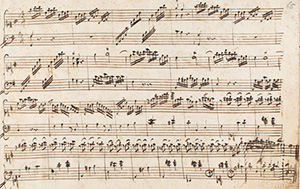
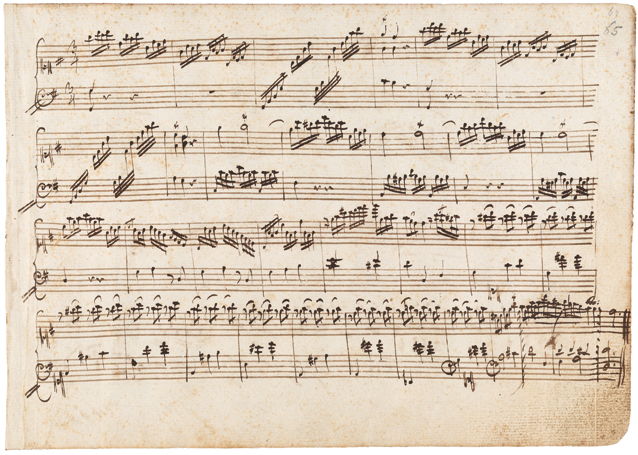
Throughout this work every object that floats over the background has been treated as an individual item which gets some of its inspiration from the musical manuscripts of Mozart at the British Library.   

The way musical notation is jotted down is as individual as the musician.  Those varied pencil marks can then produce an infinite number of options when played.  So, it is in looking at music and with the understanding of this endless variety that is music, that has been a part of what has allowed this art to quickly improve and transform.

Tiny Dancer – Elton John –  from the album Madman Across the Water

Listening to Will Smith – Wild Wild West

Billy Eckstine – Misty

Suicide Blonde – INXS

One  technical issue that had been a concern of  this artist, was to not to create an abstract musical artwork that could be dismissed as decorative:  partially defined as a painted work on canvas that has the right colors to match the furniture, and is the right size to full the space on the wall. When the thought is about decorative painting Henri  Matisse comes to mind, and what was learned from his art that actually changed this art over the years. It is in this gowning process, and the better understanding of the great variety that is music, that allowed this art to be depicted however it was wished, and that any concerns with  decoration was nonsense.  The varied use of color and shapes are needed to enhance the feel and mood of the music. Since music is usually listen to, and since these paintings have no sound, this art needed to create visually images to arouse the music inside of the viewer. Plus in practical terms it would have been boring painting standard music notation, which would have killed this art.  Thank you Matisse. Matisse is also on that short history list of influential artists starting with Vincent Van Gogh,  Rembrandt van Rijn,  Henri Matisse, Pablo Picasso, Mark Rothko, Jackson Pollock, and J.M.W Turner.

Sting – Stolen Car (Take Me Dancing)

Janis Joplin – Try

Bowling for Soup – 1985

This artist believes that this work’s style certainly pushes forward. But  its limited use of add on canvases can be seen as an unavoidable short coming of this artwork. Otherwise, the best of this art is in the style and coloration of all those half-notes, those magnificent ties, the words that are large and look great reflecting the mood of the painting in their color, and the use and variety of colors in the background.

There are now ten more works of Vivaldi’s The Four Seasons, yet to paint, with the next one beginning tomorrow, delayed because of the multiple hours required to write this one blog entry.

Listening to Take Five – Dave Brubeck

Vivaldi – The Four Seasons – Winter – 1st movement the artist favorite.

Michael Jackson – Blood on the Dance Floor

Keb’ Mo’  – Soon as I get Paid

This now brings me to this years Birthday painting that everyone, that reads this blog, will have an opportunity to receive a sign photograph of that work, t0 be painted from beginning to finish, all in one day, July 31st. I will be posting another blog entry with the details.

Ending this blog entry with The Killers – All these Things that I’ve Done

Scott Von Holzen

S_V_H Vivaldi’s “The Four Seasons(Autumn)adagio molto image6

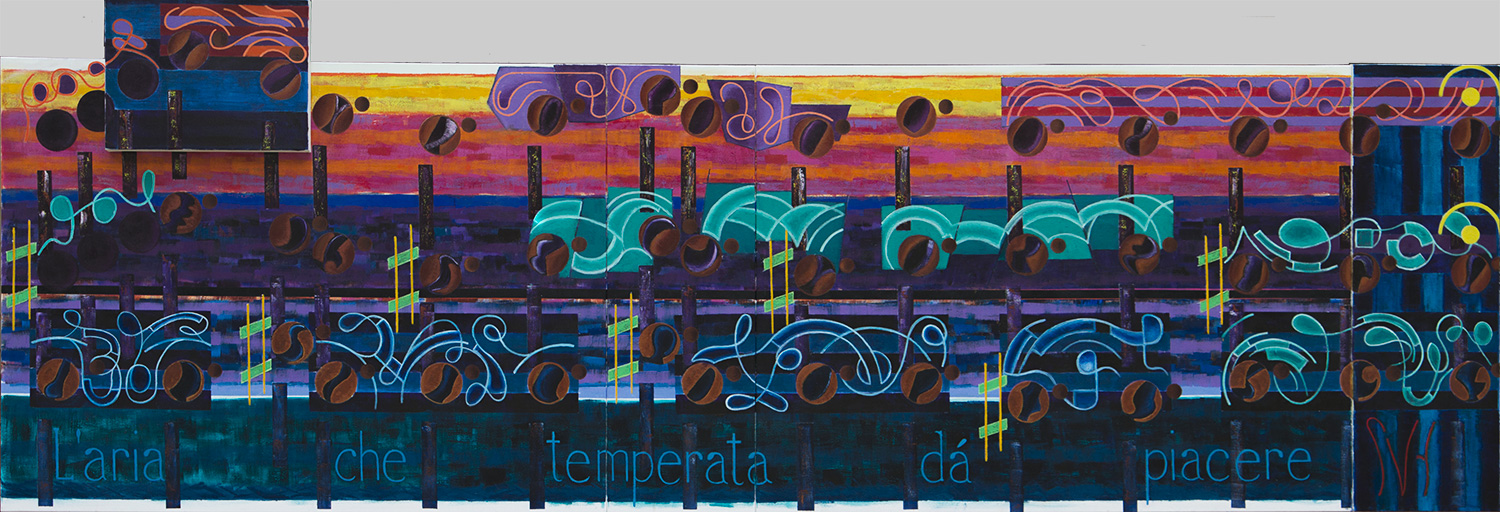
Vivaldi’s The Four Seasons – Autumn Second movement, 3 meters in length by 1 meter.  Yes, this artwork looks messy.  That will all be refined in the next couple of weeks.

Listening to Coldplay live – In My Place

Stevie Ray Vaughan – Voodoo Child

This artwork depicts the flow of this music’s ending.  The video below is not a great version of this music, but it demonstrates the expansive flex that allows music to be preformed and still be recognized, even when everyone is playing the same notes.  Taking that thought further that is why there is so much variety being put into this and the other artworks. Great music allows itself to be stretched in every direction, which brings out the creative sparks  in every performer.

The Chordettes – Mr. Sandman

Carrie Underwood – Before He Cheats

Pink – Misery

Also, I get bored using the same identical techniques in a work.  Of course repeating a style, lets say from one half note to the next, gives an artwork a smoother flow and comfortable feeling of consistency, and has it need and place.  But again, it becomes tiresome, and maybe disappointing at times, and that is when those little tweaks appear all over the canvas.  Call it this artist take on music in Cubism.  The large extent of styling in this work is because this canvas is uniquely describing three different instruments:  the top flow line  is the Principle Violin, while the second is the Primary Violin, and the third is the Cello. The desire then to give each instrument its own look, which leads to different ways of applying paint.

The words are Italian from the original Four Seasons sonnets, with a basic translation of “The mild air is pleasant.” This part of the sonnet is about the coming of the night.

Patty Griffin – Long Ride Home

Indigo Girls – Mona Lisas and Mad Hatters (Live)

Already there is some thinking ahead that comes from a work  finished in March, called The Pretender, that hangs in the living room.

That work, with the main canvas being 20 inches by 60 inches (1.5 meters) is constructed around this small canvas, which adds quite a lot of visual appeal. That does not worked with this Vivaldi canvas, because again, three different instruments are being portrayed.  But, if the next canvas is another Vivaldi work, for example, and it needs only the Principle Violin,  then there will be that option to choose a  small main canvas,  with the tacking on of the rest of the music. This will make for more  work, for sure, but it adds, challenge, interest, diversity, and fun.  We shall see.

B.B King & Eric Clapton – Days of Old

Steel and Glass – John Lennon

Aimee Mann – It’s Not.

The next effort with this Vivaldi is to change all of these white lines, into objects that are colorful, interesting, rich looking, and add a balance to this work.  That may be what will bring this effort all together.  Not sure of that, but there is this thing that occurs that leads to the finishing of every one of these works.  Something finally happens to unite the whole canvas, and at that moment  it feels that the artwork has achieved all that is expected of it.  That is when the end is near, the clean up part begins, and the mind begins the process of letting go and moving on. Such is life.

Listening to Damien Rice – 9 Crimes  &  INXS  – Pretty Vegas

Finishing this post with a future painting,  Bach – Sonata No.1 in B Minor BWV 1014 – Adagio

Scott Von Holzen