S_V_H The guilt of Art & first image of Dance Monkey

Dance Monkey first image Length currently 44 inches & variable
Dance Monkey’s debut in America

There I was in a recline chair, staring up at your standard office speckled off white tiled ceiling, with a large four blub fluorescent light focused on me, as if I was there for an interrogation. But not so. I was there for my twice a year dental cleaning. My dear in the headlights look found me noticing a round yellowed framed eight inch speaker playing some forgettable country song that was almost discernable. I mentioned to the dental assistant in between, water splashing all about my face, about the music. She was not a county fan. Later, as we waited for the doctor, she asked me what I was doing after this appointment.

I said I was going back to the studio and work on my latest project, Dance Monkey. I then asked her if she had heard of that song. She said no. I then wondered to her if she listened to music at all. She responded only on the radio. I said that was too bad, telling her that music is an important part of my life. That I listen to music throughout my day, no matter what I am doing. She said she listens to music all day at work, so when so goes home there is no interest. I then spoke to her about my regrets hearing that and listed some of the many emotional attachments I have with music, including sadness. She did not understand sad. But I do. Music makes those moments special, and so does the uplifting sound of Dance Monkey. I told her to listen to it and it would make her feel good. I said the song would bring her joy, and boast her spirit, in so many words. She then took her phone and went to website YouTube and play it. When the voice of Tones and I came on (that is the singer’s stage name) she had a sharp eye opening surprise on her face. Just moments later, the doctor came in for his quick check. I mentioned to him he should also listen to Dance Monkey for a cheering up. They both kind of laugh, but looked more confused. He left the room. Soon I was out the door, in the car, back with my music, turned up beyond my wife’s tolerance, and thrilled I was out of that environment and back in the arms of my music’s emotionally comforting embrace. I sense relief and exhilaration that a trip to the dentist had supercharged my ride home. I feel blessed. Blessed by that ride home surrounded my the music I loved, in what could have been just an ordinary musical drive back to work Thursday.

This is the first draft of the cover music for the Project Dance Monkey. From this cover’s sheet music, I chose the notation that will sampled on the artwork.

Scott Von Holzen

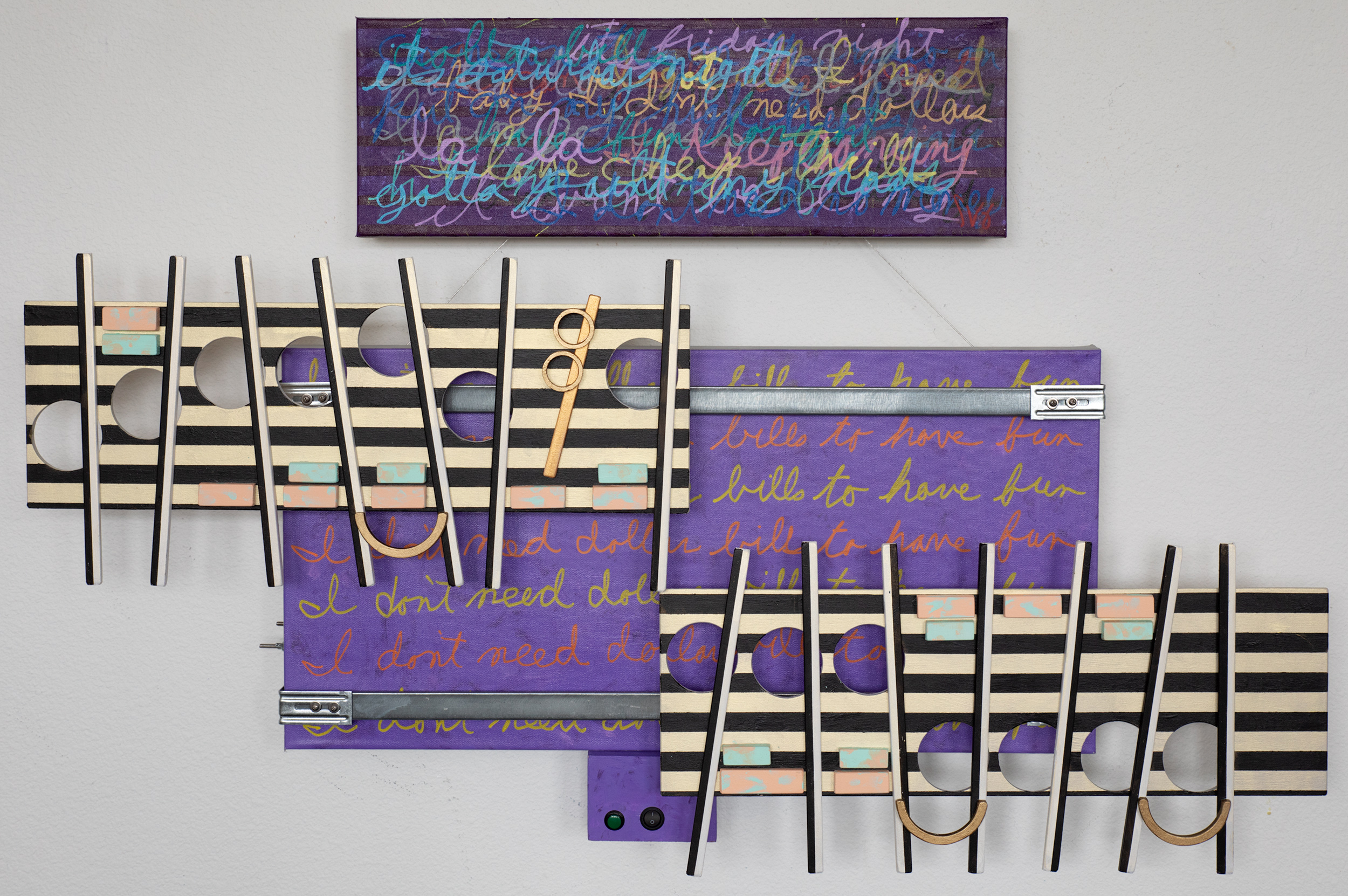
S_V_H Final image Cheap Thrills

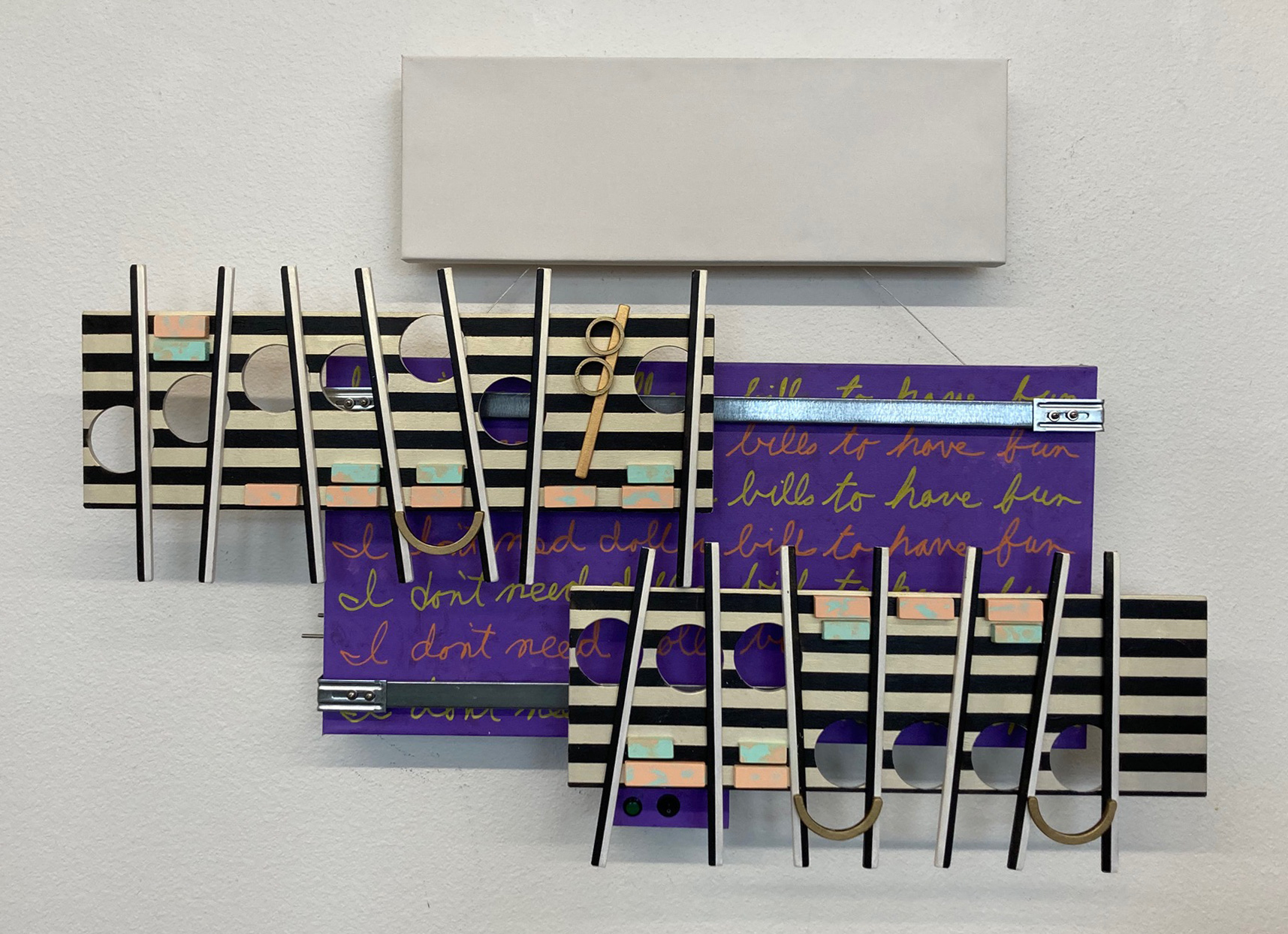
Cheap Thrills ≈L47.50″xH31.25″xD6.25″

What thrills me first about cheap thrills is the time saved when I only need to cut out circles to represent the artwork’s notation. And even more important thrill is I like what I see on the canvas that hangs the artwork. That eight by twenty-four inch canvas has multiple layers of spaghetti like words that appear to be a word salad of semi-abstraction. I place words on an artwork from the lyrics of Cheap Thrills to help bind the music to the artwork. That is why on the main canvas, my clumsy cursive writing is fairly legible.

For this mini artwork to accommodate my attention rule for mini artworks, the cover music length must be under one-minute. This requires extra shrinking down of a song, while retaining as much catchy melody as possible. The Cheap Thrills cover is 51 seconds. I compose, modify, and adjusted this cover on my desktop computer using a quality Bose speaker system. With it I can hear all the subtle differences in the sound, especially when I turn up the volume. This range of volume of the Bose system helps me to create a decent sound track for each artwork. But apparently, installing the cover music on a small 2-watt stereo system powering 4-inch 2-way speakers wastes much of the effort. I found that the 2-watt system’s lack of volume range weakens all the subtleties of the original cover sound heard on the Bose. Even the effort to maximizing the volume, no clipping, the 2-watt stereo system has no punch compared to the 20watt systems on my large artworks. On these small artworks the cover music plays out to the listener at around 60 decides. That is comparable to light conversation. Although disappointing to listen to as music, these mini works, besides their boutique portable size, play their cover music at a volume level that should not offend any listener’s ears, and be enough for most moderate sized rooms.

Not irrating the listener I found has been an issue with this art. For example, when I was picking up a large artwork after an exhibition, the curator told me that my music echoed loudly in the gallery. Obviously, this is a gallery that prefers its art to be seen but not heard. Then recently my volume issue came up when setting up the large Beatles triptych at another exhibition. That curator asked me to turn down my powerful 20-watt music boxes to conversational levels. She tested it while I adjusted the volume. The Beatles’ music lost much of its bite, its presence, and its purpose. I did not like that, but had little choice. I understood her requirements but disliked the idea of big artwork having little sound. The balance is all wrong. The good news for these mini artworks is that my volume issue should never be an issue with them until it is. Their meek sound is okay if it balances well with the dinky artworks and the stupid standard of a visitor’s conversational levels.

Here is an modified version of my Instagram post of Cheap Thrills. And yes it is silly, but here it is anyway.

Okay, after watching that YouTube video, I think I have had my fill (actually emptiness) of the audio from a 2watt stereo. The music that was playing in order to sound more normal sounding awful, I doubled the volume (increase was 10.37 decidable). I had first tried to increase the output in the software for more volume and a deeper sound, but found I had already reached the system’s limits. That is when I realized I had also reached my limit. I will update the audio on both this artwork and the other mini artwork, A Day in the Life, to the much better sounding, 20 watt system used in all the major artworks. I have another reason for this change.

I limit the cover music length on mini artworks to under one minute. The issue I found was my effort on these mini artworks audio is as time consuming and detailed orientated as the longer cover music I create for major artworks. That is because I care deeply and respectfully the music I am portraying. Therefore, why should I listen to my hard earned cover music sounding weak, tin can like, and totally lacking depth? I cannot justify that compromise any longer. I am done with 2watt audio systems. Once updated, these two mini works will have the option of actually have a range from soft to loud. This allows me to balance the sound and the art in its space. It is a good feeling that I can finally let reality return to the surface. I am eager to ride the next available wave to see if these mini works can truly float by themselves.

Cheap Thrills audio.

Scott Von Holzen

S_V_H Cheap Thrills first images

The artist Sia released this “bouncy party anthem” in 2015. This music continues its popularity to this day. Cheap Thrills is big, with almost 1 billion video views on YouTube, and on Spotify, Cheap Thrills has played over 1.7 billion times. Definitely a catchy pop song. In choosing what music to paint I take popularity into consideration. More important, the connection to the music’s rhythm along with the music’s lyrics plays a greater role in my choice of spending weeks turning music into an artwork. I did not know who or what Sia was until now. I ended up listening, for the first time, to other music by her. The quality of her music, lyrics, and video performances convinced me that Sia is cool.

Sia video on YouTube of Cheap thrills
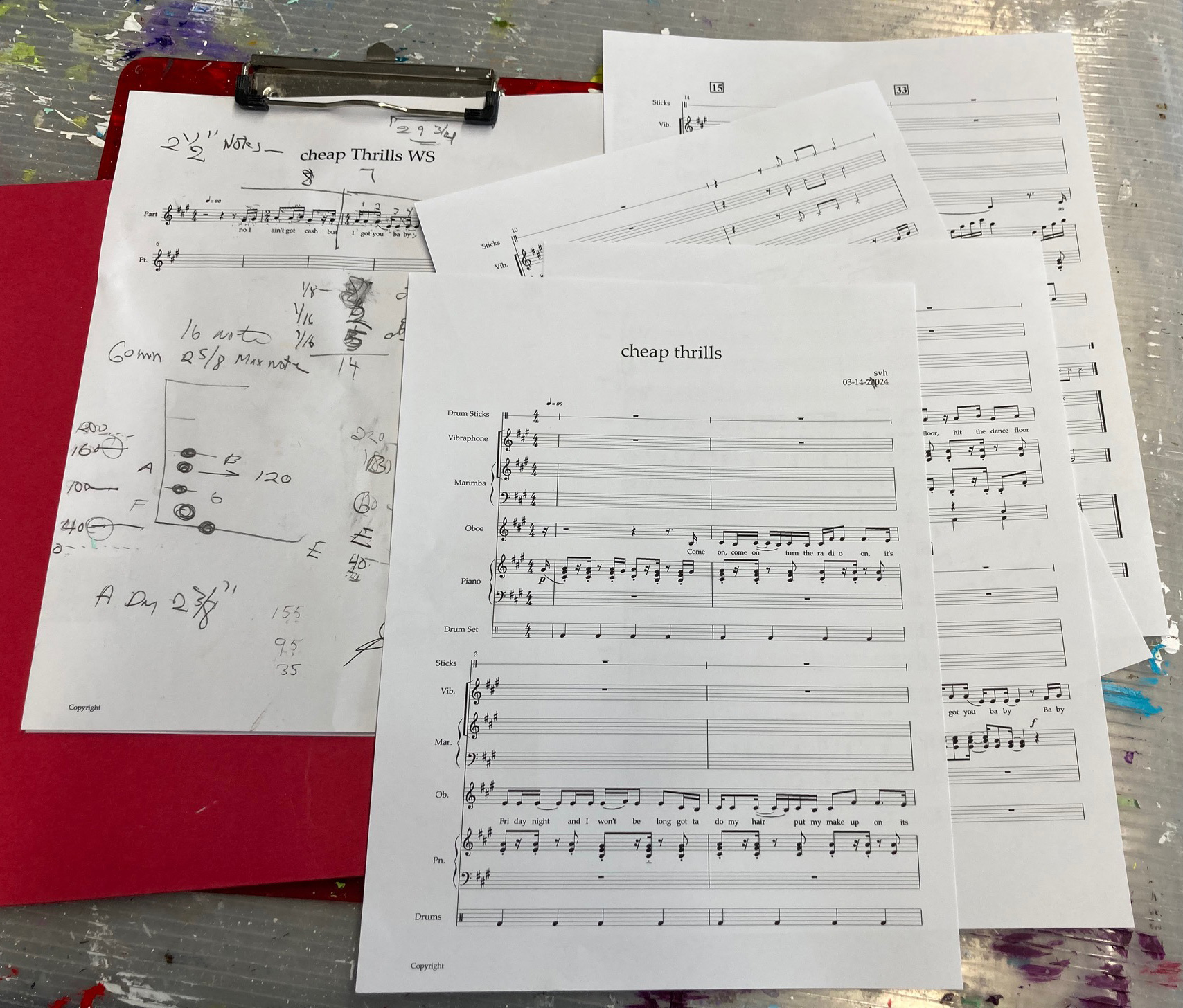
Cover music & Work Sheet for Cheap Thrills, March 14th
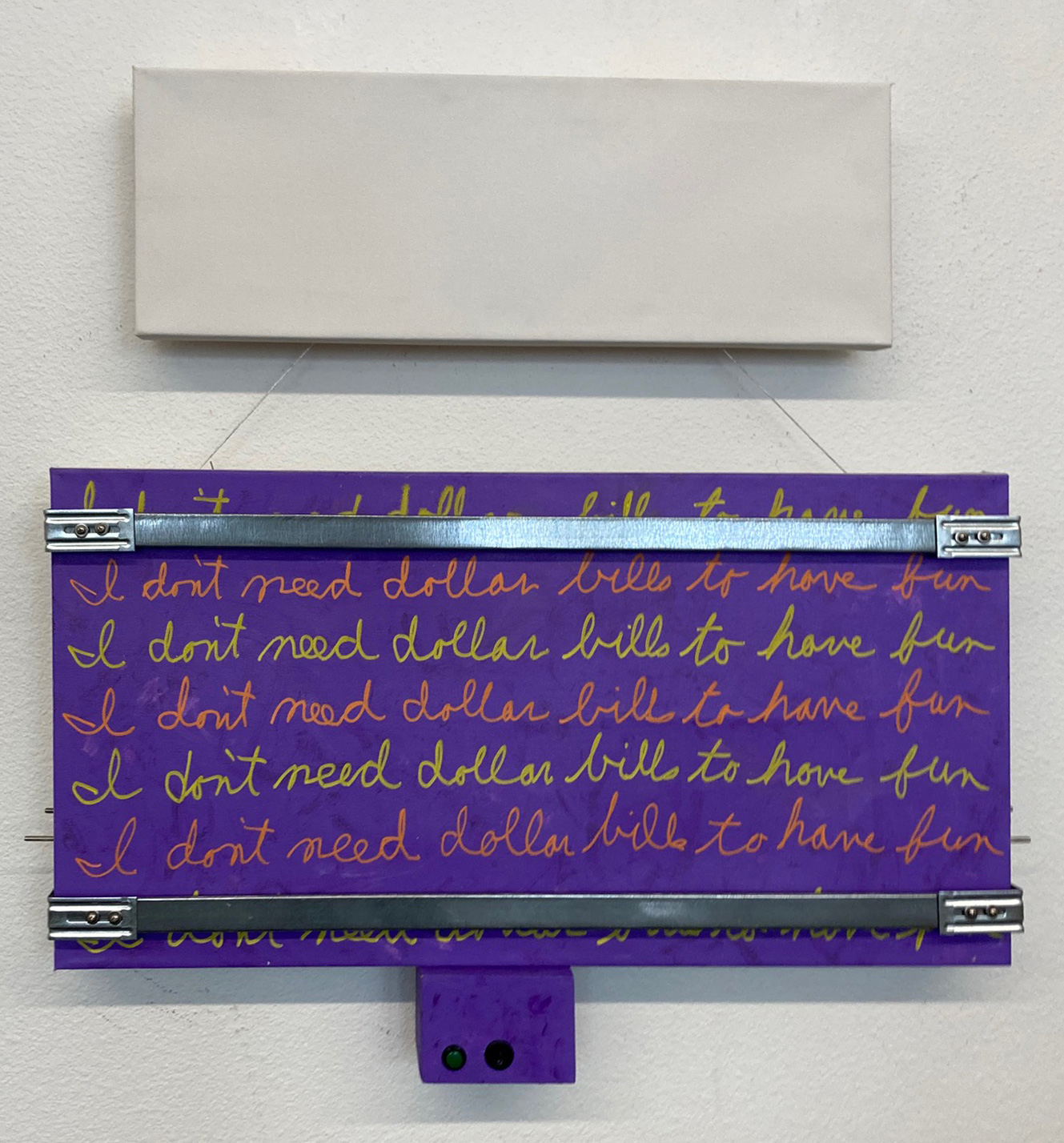
Cheap Thrills March 19th

Cheap Thrills is the second in a series of at less eight dinky artworks. Smaller size works will improve my applications chances for one-person exhibitions. My guess is I will need a minimum of ten examples of this art to show. I hope that eight tiny works along with two larger artworks will fit (it will be tight) in our Jeep Cherokee. Because each of these artworks plays the music they are portraying, and to fill blank wall space, my exhibition request will be to space all the artworks six to eight feet apart. It is important to separate the sound of the music. If the wall space is available, I would like to hang one larger work between two smaller works on each side.

As mentioned, this song is big, and in that thinking the artwork and the music box should have also been big. Instead, it is small, and so will be the music. That is a compromise I made to improve the possibilities of showing this art. “Show,” that one word, is the key to moving this art out of the studio. Look to Show, apply to show, show, show.

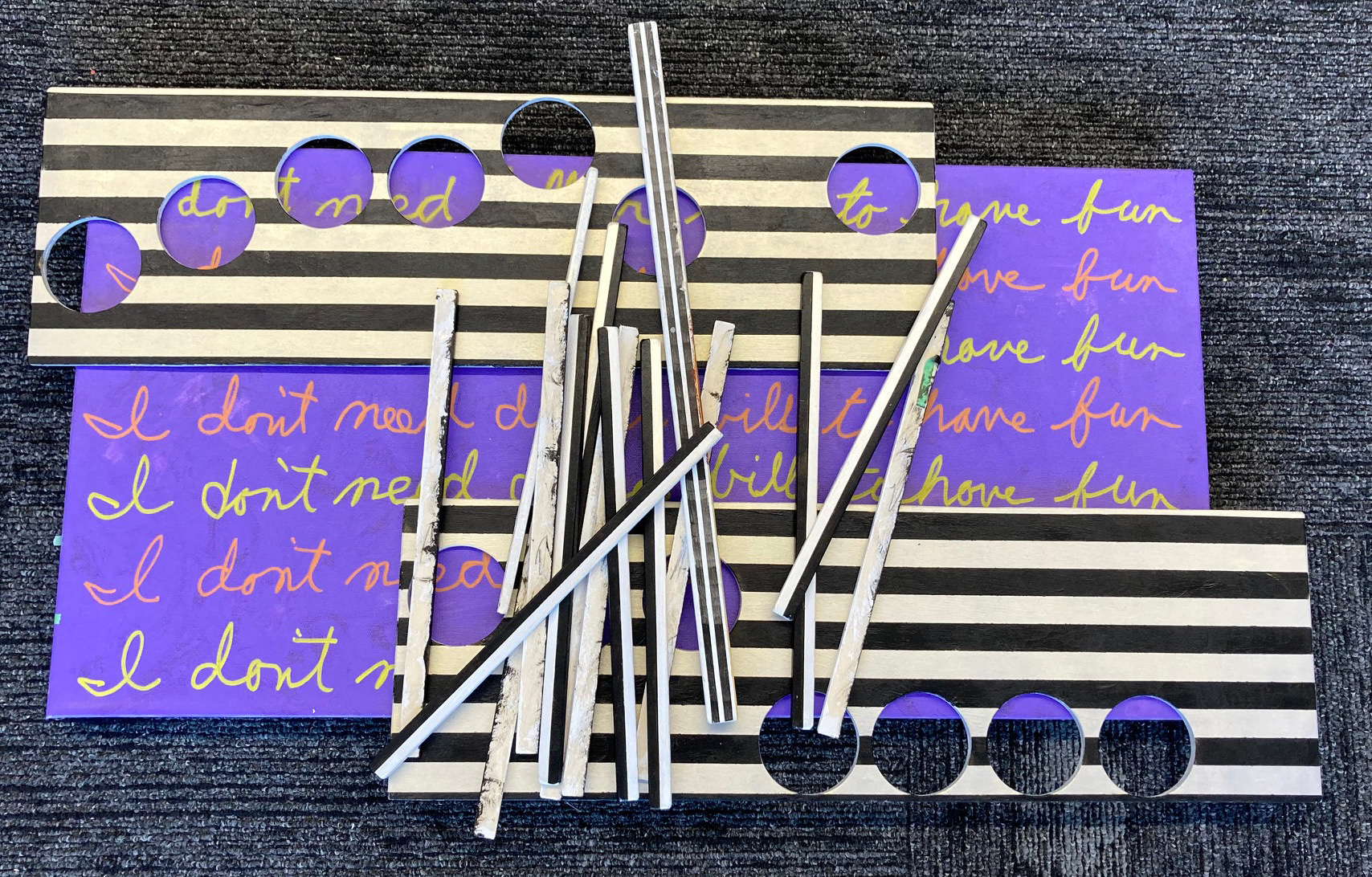
Cheap Thrills March 24th

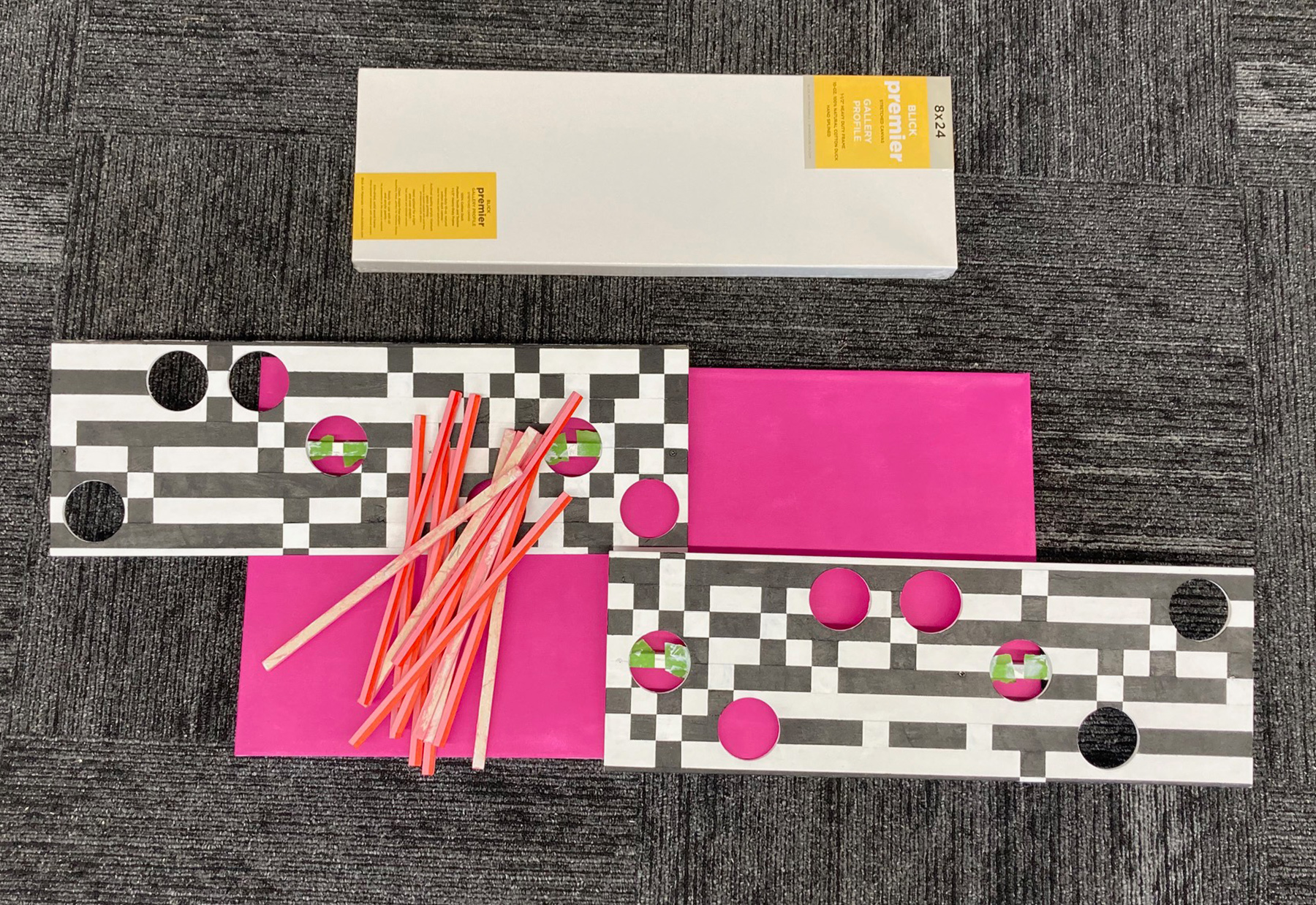
When I looked at the image above, hanging on my studio wall, it reminded me of my initial feeling when I first looked at my first small artwork, A Day. It didn’t impress me. It did not command attention, felt overwhelmed, and looked out-of-place hung on the large white studio wall. Then I tried to attach the two sections of the music, pictured below. That is when I ran into a problem. The music for this artwork is larger than A Day’s music. That caused an issue with the, glued in place, note stems of the two music sections interfering with each other. In order to find a fit, I had to shift the top musical notes to the left and the bottom notes to the right. Magnets hold each section in place. Unexpectantly I ended up placing them far off of the canvas. Extending the music this aggressively gave the artwork a less boxer, wider rectangle look, typical of my larger works. That was something I should have thought of earlier in the works design. Finally, different from A Day, I went with a larger eight inches by twenty-four inch hanging canvas. When painted, this will add to the physical look of this small piece.

Cheap Thrills ≈ L42.75″xH31″xD5.50″

Scott Von Holzen