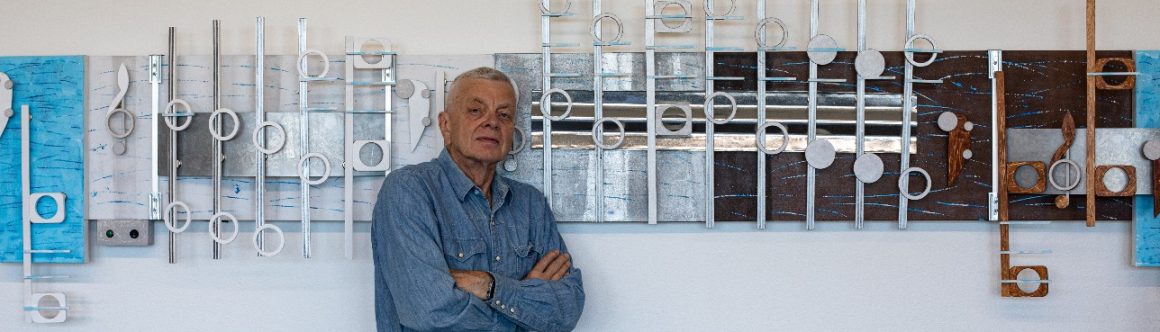
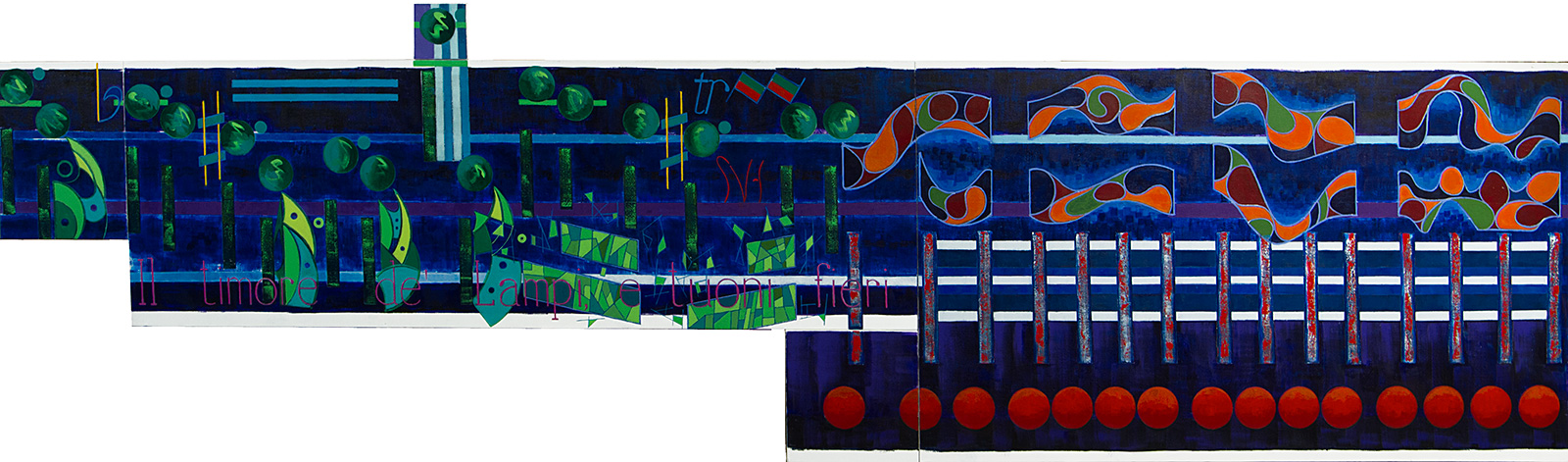
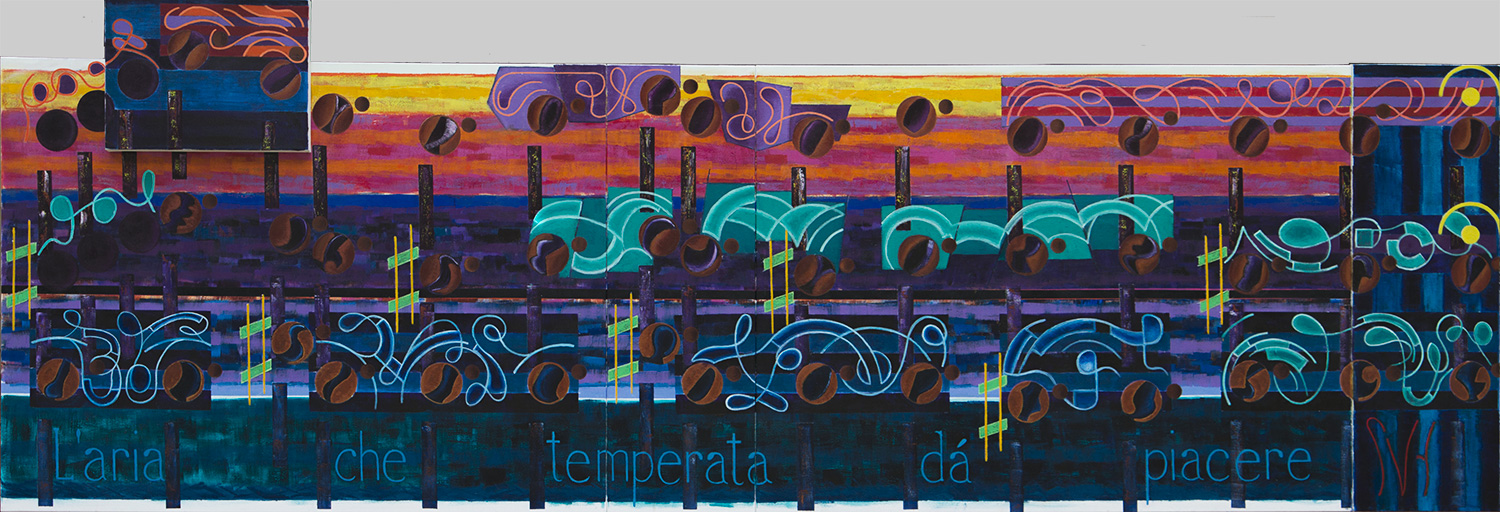
S_V_H Vivaldi’s “The Four Seasons – Summer- adagio” final image

This happily, is the completed image of Vivaldi’s Concerto No. 2 in G minor, Op. 8, RV 315, “L’estate” (Summer) 2nd movement, adagio. With a name like that no wonder it took over a five weeks to paint. This painting consists of five canvases ranging in size from 36 inches by five feet, to as small as five by five inches. This length of this artwork is 12 feet(3.66m) with a greatest height of 41 inches(1.04m).

Listening to Eddit Boyd – I’m a Fool

Count Basie – JJJump

With the artwork, The Pretender, the idea of mounting canvases in various  arrangements is dramatically displayed. To revisit The Pretender check the March 2012 blog entries. Especially by stacking canvases these artwork have taken on a sculptural appearance. This work is using stacking on a two dimension plan, which lacks the visual punch of three dimensions. Looking ahead I would like to find in the music a phrase to mapped tightly to one or two connected panels.  This would then push the rest of the music to spill over the canvas.  By letting the music flow I will then follow it with add-on canvases, which would allow more options for two-dimensional, and especially three-dimensional additions.

As I have probably mentioned in the past, a long-standing rule had been that I must make the music fit the canvas that was available.  Obviously, I could custom build a single canvas to fit, but that would be time-consuming, difficult to transfer, and of course expensive.  I am 50% Swiss, so I am always aware of how difficult it is to earn money, and how easy it is to spend it.  The realization that I can add canvas to an artwork, when needed,  has now eliminated the music must fit the canvas issue.  This not only opened up a massive amount of opportunities but gave me the excuse I need to drop that silly rule. The Music Rules.

Johann Sebastian Bach – Sonata in G major BWV 1021 adagio

Don Henley – The Heart of the Matter (Live)

Listening to Elton John – Levon

Vivaldi – Opus 3 no2 in G minor – L’estro Armonico.  Magnificent.

Tori Amos – Silent all these Years (live)

Final thoughts:  this was a challenging  painting.  Just moving it around has been a problem. A concern with this work, was to somehow make its physically awkward appearance balance.  The little add-on canvas helps this. The emphasis put on that single high note also helps.  The strong white line along the bottom of the right side strengthens  that panel, especially when it cuts over the top of the beginning bass notes. Finally, the overall business of the left side works to keep this work  level, for the most part,considering how soft in color the left side is in comparison to the  exuberant reds and oranges on the right.

The most  interesting new technique used on this work was the way that the thunder part of this music rolls and twists, and how  the beams of those notes distort the background.  This creates an interesting effect and reinforces the message of the music.

To sum up the painting progress, of Vivaldi’s Fours Seasons Series, here are the other three works that completed so far:
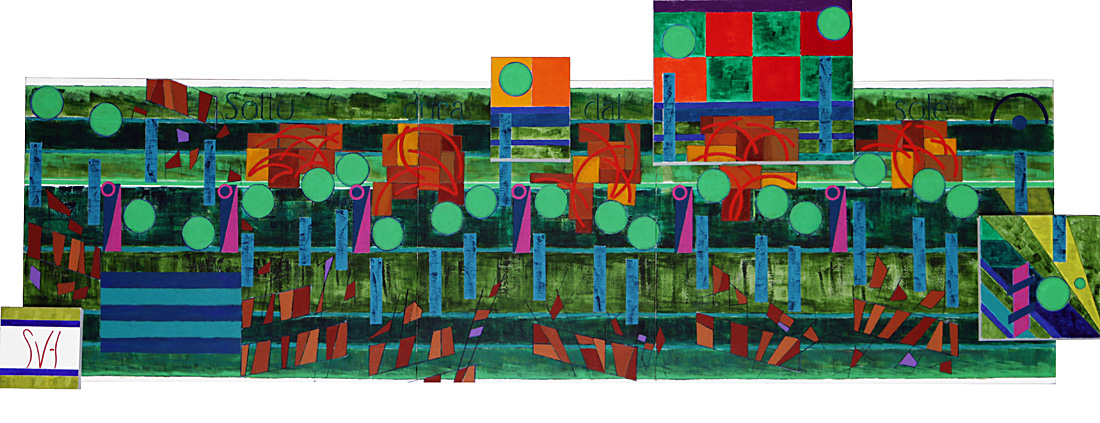
The first painting is Summer – Molto nonmolto
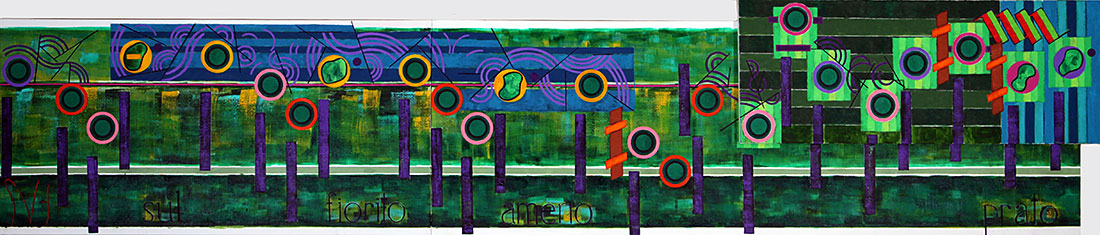
Next work painted is the Spring – largo

This third painting, my favorite,  is Autumn – adagio molto.

One reason that I am mentioning the summing up this effort so far, is that eventually there will be the need to find a place to display this Series of thirteen paintings.  Galleries or museums  plan exhibitions  years ahead.  At this point  I believe I have enough completed works  to begin the promotional push to search for a host or two.  This is not an easy task.  There is much doubt, but what choice is there, if obscurity is not an option.

Listening to Julie London – Ev’ry Time We Say Goodbye, along with the older Sarah Vaughan and her wonderful Body and Soul

The Temptations – The Way You do the Things you do.

Mario Winans – I Don’t wanna Know

Cream – Politician

Counter to the video I have not painted the middle movement, Largo,  from Winter. The reasons why is that it is too early in the year for a Winter painting.  So for now, it just seemed like the right spot to stop  and move on to the 1st and 3rd movements of the first three seasons. These movements are where the energy and the major interest is. They are the parts most people have heard.  The first and third movements artworks from this series will be the quality benchmarks.  The thinking is that the prepping and practicing is over.  The toughest challenges are ahead along with greater possible awards. I am upping the ante.

It has always been important to present on this blog and my website the best photography of this art. It has become difficult later because of their large sizes and with the attaching of other canvases. For example today I spent two hours plus retaking the  photograph of this painting for my website.  I first tried to photograph this artwork inside the studio, with artificial and  fill flash lighting. All that time was to no avail for I could not get a glare free image, no matter how I managed the lighting, except by resorting to an extreme positioning of this large bulky artwork.  I than took it outside, and photographed it in mere minutes.  Although it was completely cloudy my Canon 7D handled that light, as it should, and I could not asked for a better photograph: evenly lit and free of glare.  Obviously I need a studio with a large North or eastern light source.  Until that day arrives, I guess the best use of my time photographing these artworks will be best spent outside.  Winter will be the challenge.

Scott Von Holzen

S_V_H Vivaldi’s “The Four Seasons(Autumn)adagio molto Final image

Vivaldi’s The Four Seasons – Autumn – 2nd  movement.  This artwork is composed of five canvas panels with a total length of 120inches by 40.75 inches, maximum height.  This work was started on May 28th and now 47 days later it is finished. The guesstimate is a minimum of 3 hours a day was spent working with this artwork.  This means about 130 hours to complete.  The amount of time an artist puts into a work is not a prerequisite for value or quality, but it is good information to have when planning.

Listening to One Night in Bangkok

Melissa Ferrick – Don’t Say Goodbye

Bruce Springsteen – Streets of Philadelphia

Etta James – At Last

If I look at this painting objectively, there is not much in art history that looks  similar to this, or that approaches the way this art depicts music.   That does not mean it is any good, but there is a feeling, that this new Vivaldi work is continuing the push of this art in an interesting direction.

What then was accomplished with this artwork? We can start with those interestingly portrayed musical ties that are crazy good in this work.  This is an image of your standard sheet music musical Tie:

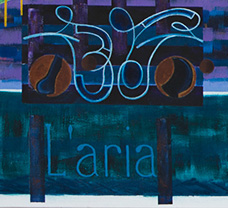
Now, here is this artist take on a musical tie from this painting:

There is no comparison, one image is of standard musical notation, and the other has nothing to do with music and is a creation from imagination. Simply put, one can be played, while the other can be either appreciated or dismissed.

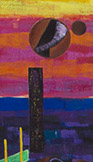
This artist take, on Vivaldi’s musical notes, took on the look of  individual planets (not intentionally) each with their own little moon (dotted half-note) that floats across the canvas.  Here is musical notation version of a dotted half-note:

 This is this artist take on a dotted half-note:

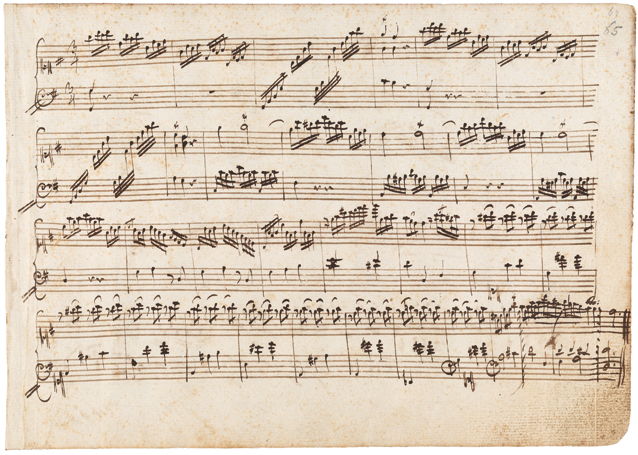
Throughout this work every object that floats over the background has been treated as an individual item which gets some of its inspiration from the musical manuscripts of Mozart at the British Library.   

The way musical notation is jotted down is as individual as the musician.  Those varied pencil marks can then produce an infinite number of options when played.  So, it is in looking at music and with the understanding of this endless variety that is music, that has been a part of what has allowed this art to quickly improve and transform.

Tiny Dancer – Elton John –  from the album Madman Across the Water

Listening to Will Smith – Wild Wild West

Billy Eckstine – Misty

Suicide Blonde – INXS

One  technical issue that had been a concern of  this artist, was to not to create an abstract musical artwork that could be dismissed as decorative:  partially defined as a painted work on canvas that has the right colors to match the furniture, and is the right size to full the space on the wall. When the thought is about decorative painting Henri  Matisse comes to mind, and what was learned from his art that actually changed this art over the years. It is in this gowning process, and the better understanding of the great variety that is music, that allowed this art to be depicted however it was wished, and that any concerns with  decoration was nonsense.  The varied use of color and shapes are needed to enhance the feel and mood of the music. Since music is usually listen to, and since these paintings have no sound, this art needed to create visually images to arouse the music inside of the viewer. Plus in practical terms it would have been boring painting standard music notation, which would have killed this art.  Thank you Matisse. Matisse is also on that short history list of influential artists starting with Vincent Van Gogh,  Rembrandt van Rijn,  Henri Matisse, Pablo Picasso, Mark Rothko, Jackson Pollock, and J.M.W Turner.

Sting – Stolen Car (Take Me Dancing)

Janis Joplin – Try

Bowling for Soup – 1985

This artist believes that this work’s style certainly pushes forward. But  its limited use of add on canvases can be seen as an unavoidable short coming of this artwork. Otherwise, the best of this art is in the style and coloration of all those half-notes, those magnificent ties, the words that are large and look great reflecting the mood of the painting in their color, and the use and variety of colors in the background.

There are now ten more works of Vivaldi’s The Four Seasons, yet to paint, with the next one beginning tomorrow, delayed because of the multiple hours required to write this one blog entry.

Listening to Take Five – Dave Brubeck

Vivaldi – The Four Seasons – Winter – 1st movement the artist favorite.

Michael Jackson – Blood on the Dance Floor

Keb’ Mo’  – Soon as I get Paid

This now brings me to this years Birthday painting that everyone, that reads this blog, will have an opportunity to receive a sign photograph of that work, t0 be painted from beginning to finish, all in one day, July 31st. I will be posting another blog entry with the details.

Ending this blog entry with The Killers – All these Things that I’ve Done

Scott Von Holzen

S_V_H Vivaldi’s “The Four Seasons(Spring)” Largo finalimage

This finishes the second canvas in this thirteen part series the painting of Vivaldi’s  The Four Seasons. This canvas is just over 120 inches(3meters) in length with a maximum height of 26.5 inches.  This painting was finished last evening but over an hour was spent today for touch-up.  The goal is never to perfect the paint. It has been only to give a good first impression of a quality technical effort.  Perfecting my painter skills will never be goal.  If it was then I could have painted this work on a computer, which would have fail miserably. From a viewing distance these lines looks perfect, but it is the moving in and seeing all of their imperfections that gives the artwork a personal depth.  That is the IT of art. That is especially important if all of those tens a thousands of brush strokes have been applied by a single hand.

Listening to B.B King – Paying the Cost to Be the Boss

Simon & Garfunkel – The Dangling Conversation

Blues Is the Road – Sonwy White and the White Flames

The Bee Gees – You Should Be Dancing

Some final thoughts on this artwork:  it has been a  surprise to see how well this canvas turned out.  Understand, this music on its own, would never have been a choice for this artist to spend over a month to complete.  Of course checking the play count Vivaldi’s Spring Largo has been played well over 60 times which did help to sink it in, and with familiarity comes understanding and appreciation.

The Verve Pipe – The Freshmen

The different colors for my notes work well even though the bright colors are only on the outside. The thought was to have them represent a variety of spring flowers.  Painting the insides with more common varieties of greens, slows the movement down  and locks them in with the background. The words speak about a pastoral of spring flowers.

The swirling light violet lines above the music are quite different from my ties in the previous canvas. They pop quite well out from with the stripped blue shaded rectangles. This style will carry over, as a rejection of  Summers Alegro Non Molto ties that now seems used up. The other ties that are darker in violet without  the added contrasting background look good, and let those more important ties, that are the heart of this music have the importance they deserve.

The far right with the vertical blue stripping,  and my two  half notes  which with that stripping,  are there to slow down the works final movement.

Above is a personal depiction of what is called a trill that is heard in this work. That small addition took more time then expected to create. The drawing with the use of heavy paint, and complementary colors reinforce the  feel of this musical ornament.

The signature is more modest on this canvas, and yet enough to help balance the side..

Bach: Concerto for 4 Harpsichords in A Minor, BWV 1065 -Mvt 1  A favorite that will be painted.

Tori Amos – Little earthquakes

Bob Seger – Night Moves  revives ones youth.

Van Morrison – Domino

Next up is the challenge, a real challenge, the second part of the Autumn concerto, Adagio Molto, which means very slow.  Yes this music is slow and not that interesting.  This is the third in Vivaldi’s Four Seasons, and also the third middle movement. There is a reason.  This series is a growing and learning process, and these smaller, less riskier parts of this great music give this artist the opportunity to stretch out,  trying different techniques, and  ideas that will evolve this style. There is still a lot of discovery yet to come.

Art is about the Art of.

Scott Von Holzen