S_V_H Vivaldi’s Spring Danza Pastorale image3

4sSpringDanza3

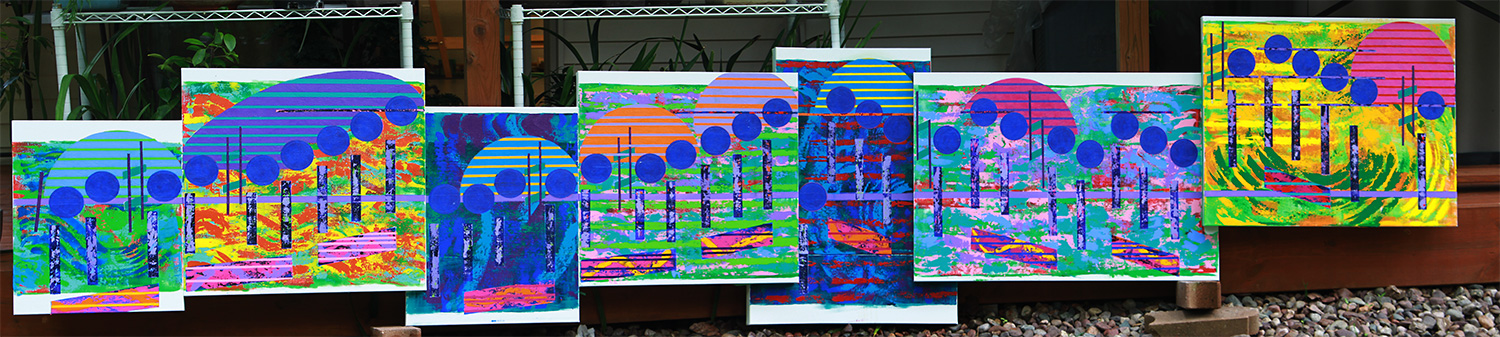
This is the eighth canvas in the Vivaldi’s The Four Seasons Series. This work is about thirteen feet in length. Again, these large images are hard to photograph and even more difficult to separate from their backgrounds.  I do not have enough natural light in my studio so to photograph an artwork  I use flash for my light source.  The problem with flash, is the issue with glare, which becomes more of a problem the larger the work.  A long artwork makes it physically impossible to find the right space to take a good photograph.  So, to get a decent image, of these large works,  I have had no other choice but to take them outside, placing  them precariously in the bright shade.  I have also found that the best way to get a good size working image is to take a left and a right photo,and then use Photomerge to put them together.  Generally, it works if  each image can be aligned with the camera,which lowers the distortion,  but this is difficult to do outside.  The final images are never perfect. That is where Photoshop comes in, to bring the two images together, creating a large detailed image.

The progress of this work has slowed for many reasons.  Right now, the beams are done, and you can see that all eight of the ties, all those colorful half circles,  have been completed.  How I will actually draw in the ties I am not sure.  One thought is that I really do not have to draw them in.  All those circles can easily represent a musical tie.  There is a similar half circle  in Blue Rondo, but in that work I did draw in the tie.  In this artwork, drawing in the ties would be a lot more time-consuming, but  I am still leaning on drawing something inside those circles.   I need to experiment, to see if I can come up with any new ideas, which is the next step in this artwork.  Unlike work were you have your fellow employees to bounce ideas of, and get feedback, a real artist is pretty much on his own.

Scott

When asked what I do, I say what my job is, but then followup with that I also  paint fine art at night.  They always ask me what have I sold.  I tell them, five works, but nothing lately.  The conversation then enters the mopping up stage where my artistry becomes defined as a hobby, which is nice and personally rewarding.  Defining  my art  as  amateur,  leaves me looking for an exit sentence.  But generally those type of conversations end quickly, which I am fine with.  It all seems like a waste of time. anyway, trying to explain myself, my art, and what goes on at night to causal viewers.  All art is  personnel, and if it is Fine Art, it exists in a world beyond the understanding of most people. These type of conversations, anyway, are about finding ways to put people in boxes, and some people have put me  in the have fun with art box.

So, that brings me to this. I think I found  how the established  Art World would perceive me, if they wished.  Here is a video link to CBS’s Outsider Art, which is Art that, at times appears similar to Folk Art, Self-Taught art, or Naïve Art.  But when I look at my art, I do not see anything that looks like Folk Art.  I do see Outsider Art in that my works  are works of  Fine Art, but just not recognized in the Main Street of the Art World. In the  video they expand greatly on my definition, in part that it  comes from “self-taught artists: that have little or “no formal training,”  whose created world has “no connections to commercial art world, to museums, to galleries.”   So now when strangers ask me about my Art, I can now say I am an Outsider Artist.   What a fine box that is.

Listening to Keane – Your Eyes Open

Scott Von Holzen

S_V_H Vivaldi’s Spring Danza Pastorale image2

4sSpringDanza2

This is second in the Spring series of  Vivaldi’s The Four Seasons.  This canvas is a nice length of just over thirteen feet.  What strikes me about this second image, is how the well the look of the music has turned out, so far.  There was a worry mentioned earlier about how was I going to make the music work with, and not simply become lost in the background.  It is obvious to me, that the music has pull that off, and is back dominating this canvas.

If you look closely above you will see that I have taped around the rectangular beams.  I am using the same spreading technique that I used on the background images, but may change that as I finish up these ten boxes.  Because there are so many of them I can see them adding to the flow of the work in a dramatic fashion, if I can make them pop, hold their form, and capture as much movement as possible.

Listening to Seal Crazy.

You may notice a little different look with the blog.  I have widen the text area and increase the size of the header image, to give site a bolder look.

Scott Von Holzen

S_V_H Vivaldi’s Spring Danza Pastorale image1

4sSpringDanza1

This Vivaldi work consists of eight canvases stretching just over thirteen feet (3.96m) and overall some 32 inches in height.  This size artwork, small in comparison to Winters Allegro, still requires a sixth easel to stabilize the work. This tells me I need to add another easel to both sides.

This is a good working size that better fits the dimensions of the painting room and this house. Another advantage in this smaller size is that the largest canvas  used is only 30 by 36 inches (1m), which means that this work does not need large amounts of paint to cover the surfaces.  This allows more experimentation at a lesser cost when mistakes need covering up. Of course,  if this work would have required bigger canvases, it would have been larger.  The length of an a new artwork comes form the musical phrase chosen, and the size of the music, which in the Vivaldi series has been at less 80 mm in diameter.

I cannot think that six months ago I would have accepted what I am doing with this canvas.  What has changed, is my use of a squeegee to apply  multiple colors, after painting the background. Across different parts and layers of these canvases, I am using multiple sizes of the squeegee , unlike  Winter Allegro, where I first used a squeegee, but only on the beams.

When I started painting, the thought of only using paint brushes felt like a limitation to me.  I knew then that  I had to find and use different methods of applying paint.   I quickly started to use 2 and 3 inch rollers and I found larger 2 and 3 inch brushes to spread the paint about. I even tried plaster brushes and even a small amount of dripping .   I then started to use different sized pallet knives, some custom cut to size, to spread the paint across the canvas.  But I found that the pallet knives created  unevenness on the canvas surface, that was fine for the background, but looked unsightly when applying the musical flow.  My only solution then was to scrap the paint down to smooth out the look for the music flow.  I soon decided that pallet knives where not the answer.  I went back to using proven brushing techniques, using only small pallet knives on the shafts of the music, and dropping rollers completely.

It was seeing a documentary about Gerhart Richter, and  his use of  a L shaped homemade squeegee, to spread his paint that I saw an opportunity.   Richter,  appears to me, to use slower drying oil paints,  that he would spread across the full length of his squeegee. This allows him to later to apply more paint that would then mix in, or scrap away layers  revealing what was under the surface.  I decided to designed and built  my squeegee.

Since I am using acrylics, that dry fast, I needed to find a different technique to apply the paint. What I first do is apply thin strips of paint on the  squeegee.  This allows me to keep part of the squeegee clean, which prevents the bottom layers from totally disappearing.  When dry, I can then add more layers of different colors,  spread on only parts of the squeegee. Each time I  draw  it  slowly across the canvas, watching and changing how the squeegee interacts with the paint. This application technique leaves flat layers, for the most part,  unlike rough uneven surface I was getting with pallet knives.

If you look back on the Vivaldi series you can see how I have evolved the backgrounds to have more of an interaction and effect on the music.   The flow of music remains the strength of these works, but from the beginnings of this art I have struggle to understand what  the purpose of the background is in these artworks, besides adding contrast and covering the white surface, for the music flow.

What I am seeing now is an opportunity to represent in the background, not only as decoration, but as the bass of the music like the music flow represents  the soprano of the music. Constructing the background to represent the look and feel of the music’s bass is an interesting idea, that needs more thought.  We shall see what may evolve out as this idea, as this art keeps  moving forward.

Scott Von Holzen