
S_V_H Vivaldi’s Four Seasons Summer Presto image4 & 5

summerPresto4

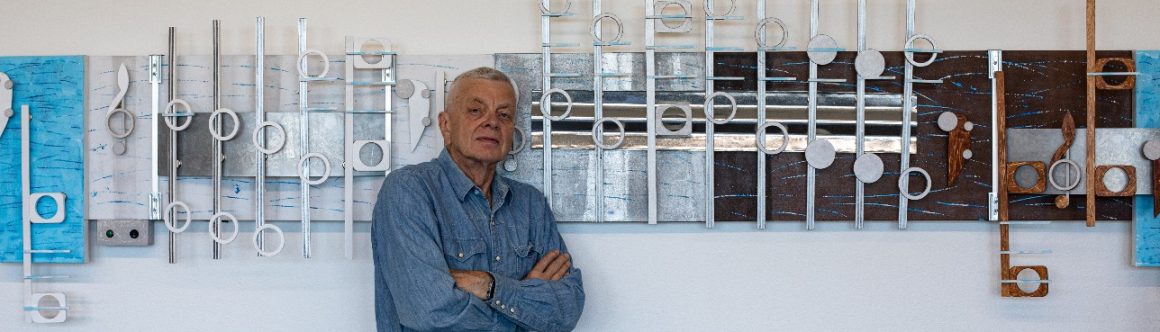
The Four Season’s Summer Presto sound and feel is that of pounding rain during a raging summer storm.  To capture some of the quickness,  excitement, and the sharply cutting sounds of this music  I am using the contrast of colors in light and dark shades.  By using all of the different elements of this music, hopefully this twenty foot artwork will eventually take on the look of a big bad storm on canvas.

Because the color blue seems a natural  for depicting  bad weather I have a range of contrasting shades to represent the flow of the music.  To introduce areas of brighter colors  I have turned to other musical elements in the music such as  the rests and the incidentals.  These smaller pieces from this music are minor, but besides filling spaces, they add lots of points of interest.

In the image above, a number of the rests are painted in red and green. A rest  pauses the music for an exact amount of time,  based on its style  Below, are two examples of rests, with the first pause being an 8th of one beat, followed by a 16th of a beat.
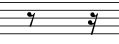
restsIn this painting the red lines, of a rest, have a stopping effect, while the green for the circles are the complementary color of red, creating a back-en-forth effect.  Besides the rests  the other objects that add interest are the sharp, flat, or neutral, which in musical terms are all incidentals. The sharp raises the pitch of a note a-half step, a flat does the opposite, and the last image is of a neutral which is the natural sound of the music.Accidentals
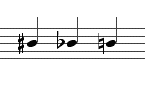
With the sharps. I first tried using a deep red for the legs, and a light magenta for the two arms.  It looked awful. Those bright colors, in between the blues of the music,  blocked the flow.  I  toned down the sharps by painting them a light blue, but then noticed that  the size of the sharps where too large in comparison to the the music. Since I had already framed in all sixteen sharps, which took considerable time, I needed to find  way to reduce their size without removing and redrawing them. My solution was to use darker shades of blue, to make one side of the sharp recede into the canvas. That help,  but in a serendipity moment, I removed a piece of tape that I was using to edge a color, and under the tape was a small strip of the original light blue color.  I knew then that by striping the sharps, and later the flats, would give them a unique look without conflicting with the flow of the music.  For the red and green rests they all appear before the music, and not in the flow, so I left them alone.

When I first started to put together my plan for this final painting of the Vivaldi Four Seasons series, I went back and looked at the twelve other paintings  and how each of them came up with their unique solutions.  My first thoughts about this last painting, was to do a composition that uses many of these different ideas from the past Four Seasons artworks.  I suppose, I thought it might be an easy way to start probably the most important artwork of the series.  But that idea soon was forgotten. I found, like  with so many starts in the past, I can borrow but not steal.

To explain, I have always looked at previous works to see what worked well with them, and what if anything that would help me with a step or two with new artwork. That actually does work, but only in minor ways, because certainly there are some common techniques that are shared between artworks, but because the subject, music, is so diverse I never end up following only one path on the way to complete a painting. With growing experience from producing these paintings I have learned that the best way to start a new artwork is to find the right amount of canvas for the music, pick a couple of colors that seem natural, play the music a lot,  and then make that first move to put paint on the white canvas. That is when a new affair between the music, the artwork, and me, all begins.

After painting many paths I finally reach that next special moment when I am seeing the true personally of the artwork coming to the surface of the canvas. It is seeing that special something on that canvas, that convinces me that a new artwork can be cool. It is like that first touch in a new relationship, when you go from smiles to a kiss.

summerPresto5

It has been a number of days since I started writing this blog entry. I have now made significant progress with Summer Presto, actually reaching the kissing stage.  I am confident I am seeing this works own unique identity coming into view.  It is a good feeling. A sense of finally understanding the direction this artwork wishes to go.  And the relief of knowing “I am good to go,”  and that soon there will begin, all over, the anticipation of what the next artwork will bring.

Scott Von Holzen

S_V_H Vivaldi’s Four Seasons Summer Presto image2

summerPresto_2

Summer Presto from the Vivaldi Four Seasons series.  Composed of eight panels each thirty inches, this artwork reaches a length of twenty feet.  What you are seeing is the background completed, for now.  Blue dominates this artwork because  the theme of this movement, from the Summer concerto, is a  storm.  Along the edges I have created the forward and backward flow that appears in the clouds of an approaching storm. The narrow strips in the two wide bars of color is where much of the music will appear.  Then between the music I again have gone with another back-en-forth created from using two different patterns. This neutral area does then add interest, drama, and variety to the artwork.

Understand, this music is about a  summer storm, but I am in no way trying to physically depict a weather scene. Thousands of artists that can do that better than I would ever.  Instead, I am going for something less predictable, which I would think, can represent nature, but also shows the range of this artist’s style. If you stand far enough back, to take in the entire work,  you would see that it is the center area of this artwork that dominates this work. Those sections are there not to represent the storm theme, although, they strangely enough, work will with the rest of the background.  Their main purpose is to shake up this artwork,  challenging me, and the viewer to take this artwork beyond the music.

For now, this is it for this artwork. With the Holidays coming up I need to turn my attention to this years Christmas painting.  For 2014 I am painting A Big Red Sled, made popular by the band, The Killers. It is an interesting piece of music that I can relate to, and I find the music interesting.. Normally, my first thought about the Christmas artwork,  is to keep it simple and easy. I tried that with this music, but I could not do that which lead to the struggle to except that part of the music that was the most difficult. Next, I had difficulty finding a physical design for the music. Last night I thought I figured it all out, and prepped three larger canvases for the artwork. This morning I was looking at my earlier Christmas works, and the 2012, Let it Snow, made me change my mind.  I have now finished a new setup for this artwork that consists of smaller canvases, but more of them.  I have gone from three large flat canvases to six, with four to be attached on top of the background. As far has the look, I am seeing wide bands of gold with narrow silver strips for separation. That is about in for Big Red Sled, for now.

As for the Vivaldi I will work on it, here and there, over the next month, and post a new update in early January.

Scott von Holzen


S_V_H Vivaldi’s Four Seasons Summer Presto image1

summerPresto_1


This is the last great painting of The Four Seasons, that I started in March of 2012.  When finished this series will consist of be thirteen paintings in all. You can see the previous Vivaldi Four Seasons works at this Page.  You can tell by  the enlargement,  of this first image, that this is a large painting. It consists of eight canvas panels each thirty inches by thirty inches, for a total length of twenty-feet. This is certainly the longest work of the Vivaldi series, and very near being the largest in the group. The length of this work quickly adds up when you consider that the 64 painted strips, in this first image, total  1,280 feet of paint.

Here is a good orchestra version of this 3rd Movement from Summer.  What you will see in the painting is from the 24th second to the 32nd second of this music.

I have a David Garrett version that is a favorite of mine,  but could not find it on YouTube.  Here is another YouTube version by him:

This third movement is nickname The Storm, so it is a bad weather related image I see.  I picked those 8 seconds from the music because you can hear and feel the driving rain and hall. The words I have chosen from the  Summer Sonnet are from the line: Thunder and lighting split the Heavens, and hail-stones.

Obviously, I expect to be using a lot of dark colors, mostly blues, maybe with some dark greens, along with a lot of different splashes of bright colors to increase the drama and movement in the work. You can see some beginnings of this sense of movement by looking into these two wide strips at the random shades of blue.

All eight canvases are of the same size, with each representing, in musical terms one measure. By being connected at various heights they follow the up and down of he music, which adds to the sense of movement.

This work along with the other twelve canvas will eventually be sold as one. As I have mentioned in the past, I do not want these works split up.  I do not expect, except on rare occasions,  that I will ever see all thirteen artworks on display together.  I do see them being shown,  by the season they represent in smaller groups of three, with Summer having four works. Whoever purchases these works, I am certain will be strongly connected to all of them. I can say this  from what I have learned by the reactions from the patrons of this art.

These are people with money in the game, and so I know they are being honest. I have been constantly surprised by the bond that forms between the artwork and the owner. I cannot explain it. I do not understand it. But it is there.

What I do know is that even though I put everything I have into creating these works, that in itself appears to have little to do with how others react to them. They see something else in their artwork that becomes important for them. They do not visualize whatever I did to create them, or my reasoning behind the works creation.  They do form a special attachment to their artwork.  And that I do understand. In whatever shape that bond is, I too have it.

For me it is that mysterious something, that captivates, and pushes me to see, to know, and to find out how far this art can go. In short it is that something that is unknown, not only for me, but for those that own these works, that brings this art meaning.  And for the owners of these artworks, I can only thank them, for I have consistently fallen short of understanding just what is going on. I guess, that will remain, the conundrum that so far I have no right answer.  That is just fine with me. I find it fun not knowing.

Scott Von Holzen
