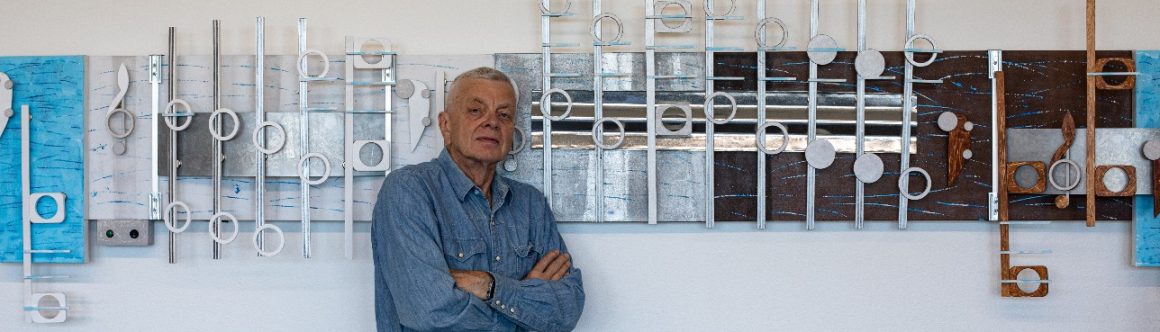

S_V_H Vivaldi’s “The Four Seasons(Summer)” Allegro Non Molto image 1&2

Image one should be titled “Three panels with green line,” and this would have been taken seriously, 30 years ago.  But, today the green line is just the first applied paint in the start of a 13 canvases series based on the music,  The Four Seasons, by Antonio Vivaldi.  This music consists of 4 concertos: Spring RV 269, Summer RV 315, Autumn RV 293, and Winter RV 299. These 4 concertos consist of 13 movements, or twelve, if you consider the short piece that begins Summer, as a part of the Allegro.  That short piece is the first work of this series.

If you wish, listen to the first minute of the first Movement of the Summer Concerto,  Allegro Non Molto, at the Four Seasons link above.  It is a little fast for me so I prefer this YouTube link,  Trondheim Soloists,  that extends this short part to one minute and thirty-two seconds.

Back to the lone green line.  The purpose of that line in this canvas is to present a continuum.  It bonds the main three panels in a work that is, in total length, 110 inches (2.794m).
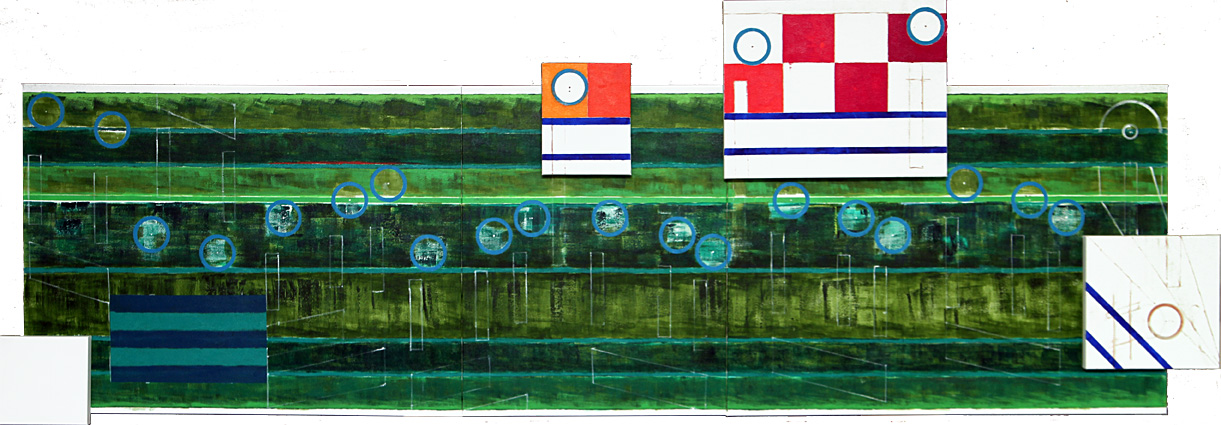
This second image was taken a couple of days ago. The smaller, add-on canvases, make the the  painting  more interesting, challenging, and add another dimension,  to better depict the flow of the music.  The large squares are there to slow the music flow down, unlike the original thought to use narrow strips.  In later Summer works, when the music is at times punchy, I can see the use of narrow lines to better increase the feel of movement in the work.

Listening to Mozart KV242 Concerto for 3 pianos.

Green has not been comfortable color for this artist, for unknown reasons. In work done lately,  it has been used only for small splashes of contrast.  The Birthday painting from 2010 was the last large use of green, but Summer has 4 canvases, so there will be a lot of bright, strong greens, and hopefully, more creative uses of this color family, still to come.

Listening to Emmylou Harris – I Will Dream

Scott Von Holzen

S_V_H The Pretender final image

The final image of The Pretender from the music by Jackson Browne.  This first thing that is noticed is how small this painting is to those canvases that are around it.   The second perception is how strong this work stands, and how easily it makes its presence apparent in the room.  Obviously, it is the addition of the three other canvases that feel to be well placed, well balanced, and together add interest and uniqueness to the work. Although far from perfect, this artist never strives long for perfection.  Artistic perfection is a journey, a quest, an adventure, but never the goal.

Again, the colors appear, a little strong on my monitor, but a lot has to do with lighting, and this image is as close to reality as time an effort permit. Another thing that is wondered about with this type of work is how do you frame them.  I believe, to stabilize an artwork over time, a good frame is important, and yet, look at the challenge.  The thought is that someday to frame the main canvas and do cut outs around the three smaller attached pieces. Since the smaller canvases are fairly heavy and well constructed, they will probably maintain their shape well into the future, if the main canvas is well framed.

This work comes off well.  The words used can relate to the music, but they also can have many different meanings to the viewer.  The colors are varied and interesting, and they seem to all work well together, and with the music.  The work flows nicely from left to right with a soft beginning and a dynamic ending.

Now, next up is a very, very large project.  What this artist needs to do to make his statement is that is going to be attempted next.  This artist plans on over the next couple of years to do  Antonio Vivaldi’s The Four Seasons.  All twelve parts will be done on thirteen canvases starting with Summer RV 315, part 1, the first minute or so, of the Allegro non molto, which is the thirteenth work. This part of part one of Summer, just feels right to do as a separate work, especially considering how different it is from the rest of the Allegro. I do understand that there is a huge amount of knowledge that has to be learned about Vivaldi and this music, but for now I am going by this artist rules, until future knowledge says else wise

Then when all the pieces of The Four Seasons are completed, and framed, the thought is to put them on exhibition.  The plan, right now, is to put each Season in its own area and have the music playing in the background to match. The location for the first display will probably be here, where I live, and then hopefully we can go on the road, maybe to Madison, Milwaukee, and Chicago.

We shall see.  Right now this is all only a dream.  Not a single thing as been accomplished so far, besides the birth of an idea. There will be many obstacles, and not just time and money. We will all learn what this artist is made of.

Thanks, to all of you that have commented and click the Like button.  We are on our way.

Scott Von Holzen

S_V_H The Pretender image5

The Pretender 20 inches by 5 feet (1.524m) with three add on canvases.  The colors are appearing a little on the bright side on my monitor, so there is still some work to be done, to offer a realistic representation.

This week and more, have been filled with interruptions and other obligations, but no matter,  the time that is spent with this work have produced, small, but productive efforts.

The song and the words of The Pretender are soft and reflective, while still maintaining a rock beat.  This is a constant reminder when it comes to color choices.  It is important to maintain the mood of  this music, so that is why the blues and darker purples are there. The splashes of bright color add musical and artist contrasts, because, in many ways, this is an upbeat song:  it is the excepting of one’s own fate, and then getting on with it.

Musical slurs are a part of this painting. You see a lot of them on the lower right added canvas.  They have been evolving, in style, a lot this last year.  The  issue with slurs has always been how to make them stand out. That is where the different colored boxes help to do.  The boxes eliminated the need to work with the painting’s background color.

Now, after doing a number of canvases, with this  slur -in-box style, there has been some questioning. Going back to Van Gogh, again, and looking at a number of his olive tree paintings from 1889, the wonder is could Van Gogh’s late style be worked into these slurs, to open up the look?  Hum?

Hopefully this artwork will be done this week, which would be about a month spent.  That time spent is to long for a work of this size.  But, since finished works are display only a few months and then stored away, it may be time that is do to it.

Scott Von Holzen