
S_V_H Vivaldi’s Four Seasons Summer Presto Final Image

summerPrestoFinal

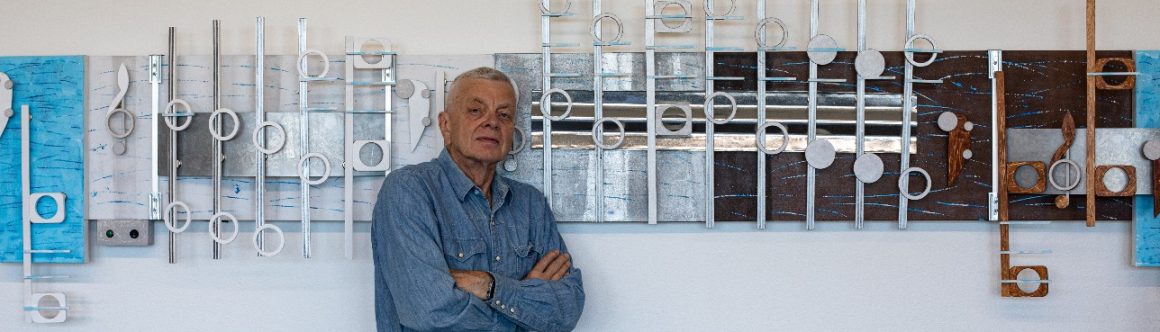
This is the final image of Vivaldi Summer Presto Third movement from The Four Seasons concertos. This twenty-foot artwork is  the last artwork in the thirteen painting Vivaldi series that I started almost three years ago, March of 2012.  I have always believed that I could actually accomplished this project.  The surprised is that this could be done.

This is the longest painting in the Vivaldi series.  I can say that this is also the most complicated painting from that group that took an incredible long time to complete.  Looking at my notes I put together the plan for this artwork on November 5th, actually starting the project on November 8th. I put a finish date on the back of this artwork of February 25th.  I actually signed it on the 26th, and on the 26th I realized I had missed a part I wish to add from the music. That small addition, added to all eight panels I finished on the 27th. Summer Presto was then photographed, and I created the video for the walk through.

This painting owes much to the other Four Seasons paintings, but like the other twelve artworks, this one stands out as its own unique work of art. When I approach this last artwork I kind of wanted it to be a summary of  the past works, or an artwork that took from the past, and turned it into more than the sum of the rest. That did not happen. Each artwork eventually finds it own way, and eventually I see that and then I do my best to catch up to the obvious in front of me.  They become something beyond me. They guide, they demand, they expect, and they always win. I do their bidding.

I became an artist, in the hope, to get back my definition of me,  that I felt I lost in 1993 (long story). That might sound ridiculous, and I agree, but I want to be known as Scott the Artist (another long story). A secondary goal is that I would like to be the boss of my life (silly but true).  I may eventual gain my identity back, but the boss I will probably never be. These Vivaldi artworks make it clear to me each time I sign my name, who is in charge. I am their caregiver.

After working on a single artwork for almost four months most of the excitement that goes into creating art gets spread  thin across such a considerable amount of time that there is little emotion left when done. Right now I feel good that this series is over, but I do not feel any urge to celebrate. I guess my feelings towards the Vivaldi Group will not change because the only way I can see all thirteen paintings is to view them on the website. Even though all the Four Seasons painting are within fifty feet of me stacked away where all I can see are the parts that stick out from storage. The only three paintings, I can view in their entirely,  are Summer Presto on my easels, Winter Largo that has hung below my bookshelf ever since I completed it  a year ago, and hanging in the living room wall is Spring allegro.  My joy and pride will be there when all thirteen painting are on view. I am thinking my reaction of seeing them all together would be the same as Vincent Van Goghs, when he first saw his artworks scattered all through the apartment, while visiting Theo in Paris.  When and how that day is going to happen is the next chapter in this story.

Let me talk about chapter two of the Four Seasons Paintings.  I will be putting together a new website dedicated to these thirteen paintings, to display, and to promote them. This website will have one goal and that is to give free to an art museum, hopefully in America, this entire Vivaldi The Four Seasons series. This will be an interesting chapter, that hopefully adds a lot charm to this story of a boy and the dream to be something more than me.

Scott Von Holzen

S_V_H Vivaldi’s Four Seasons Summer Presto image6

summerPresto6Vivaldi The Four Seasons Summer Presto.  If you compare this image with the other twelve Vivaldi paintings from the Four Seasons Series you would think I am near done.  I have finished adding the music, but I am far from done with the background.

This next video is by the soloist Julie Fischer. The Summer Presto starts and the 7:30 mark.  Listen to the music that is this  painting from 7:52 to 8:02. That is a total of ten seconds being preformed on a twenty-foot canvas, which means this music moves fast.

In this artwork I need to now add the speed of the music, and the feeling of a driving rain storm.  I plan on doing that by painting contrasting motion with a freer hand.  I have some ideas how to do this. The obvious risk to this artwork, is making bad judgements, and damaging what I have already accomplished. And yet, I have known for weeks, that  I have to somehow depict the storm, in some form by letting free my inner Jackson Pollack, and the musician Prince.

I have a lot on the line with this the last Four Seasons Vivaldi. I want this artwork, that  ends this project, to finish with a big crescendo. It is not that I actually have to present images of rain. What I am after is more the idea, or the concept of a downpour during a storm I will be looking for. This will need patience, for I am going to error, and I am going to have to quickly wipe away my mistakes.  This part of this artwork is gong to be frustrating and it is going to take a few weeks, that I am not looking forward to. And maybe, when done, I will not quit end up being there in bringing out my inner Pollack and Purple Rain.  How ever this artwork finishes, it will end with a big image that sticks, and pops, that hopefully moves this style just a bit more forward.


Scott Von Holzen

S_V_H Vivaldi’s Four Seasons Summer Presto image4 & 5

summerPresto4

The Four Season’s Summer Presto sound and feel is that of pounding rain during a raging summer storm.  To capture some of the quickness,  excitement, and the sharply cutting sounds of this music  I am using the contrast of colors in light and dark shades.  By using all of the different elements of this music, hopefully this twenty foot artwork will eventually take on the look of a big bad storm on canvas.

Because the color blue seems a natural  for depicting  bad weather I have a range of contrasting shades to represent the flow of the music.  To introduce areas of brighter colors  I have turned to other musical elements in the music such as  the rests and the incidentals.  These smaller pieces from this music are minor, but besides filling spaces, they add lots of points of interest.

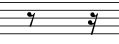
In the image above, a number of the rests are painted in red and green. A rest  pauses the music for an exact amount of time,  based on its style  Below, are two examples of rests, with the first pause being an 8th of one beat, followed by a 16th of a beat.
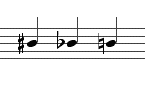
restsIn this painting the red lines, of a rest, have a stopping effect, while the green for the circles are the complementary color of red, creating a back-en-forth effect.  Besides the rests  the other objects that add interest are the sharp, flat, or neutral, which in musical terms are all incidentals. The sharp raises the pitch of a note a-half step, a flat does the opposite, and the last image is of a neutral which is the natural sound of the music.Accidentals
With the sharps. I first tried using a deep red for the legs, and a light magenta for the two arms.  It looked awful. Those bright colors, in between the blues of the music,  blocked the flow.  I  toned down the sharps by painting them a light blue, but then noticed that  the size of the sharps where too large in comparison to the the music. Since I had already framed in all sixteen sharps, which took considerable time, I needed to find  way to reduce their size without removing and redrawing them. My solution was to use darker shades of blue, to make one side of the sharp recede into the canvas. That help,  but in a serendipity moment, I removed a piece of tape that I was using to edge a color, and under the tape was a small strip of the original light blue color.  I knew then that by striping the sharps, and later the flats, would give them a unique look without conflicting with the flow of the music.  For the red and green rests they all appear before the music, and not in the flow, so I left them alone.

When I first started to put together my plan for this final painting of the Vivaldi Four Seasons series, I went back and looked at the twelve other paintings  and how each of them came up with their unique solutions.  My first thoughts about this last painting, was to do a composition that uses many of these different ideas from the past Four Seasons artworks.  I suppose, I thought it might be an easy way to start probably the most important artwork of the series.  But that idea soon was forgotten. I found, like  with so many starts in the past, I can borrow but not steal.

To explain, I have always looked at previous works to see what worked well with them, and what if anything that would help me with a step or two with new artwork. That actually does work, but only in minor ways, because certainly there are some common techniques that are shared between artworks, but because the subject, music, is so diverse I never end up following only one path on the way to complete a painting. With growing experience from producing these paintings I have learned that the best way to start a new artwork is to find the right amount of canvas for the music, pick a couple of colors that seem natural, play the music a lot,  and then make that first move to put paint on the white canvas. That is when a new affair between the music, the artwork, and me, all begins.

After painting many paths I finally reach that next special moment when I am seeing the true personally of the artwork coming to the surface of the canvas. It is seeing that special something on that canvas, that convinces me that a new artwork can be cool. It is like that first touch in a new relationship, when you go from smiles to a kiss.

summerPresto5

It has been a number of days since I started writing this blog entry. I have now made significant progress with Summer Presto, actually reaching the kissing stage.  I am confident I am seeing this works own unique identity coming into view.  It is a good feeling. A sense of finally understanding the direction this artwork wishes to go.  And the relief of knowing “I am good to go,”  and that soon there will begin, all over, the anticipation of what the next artwork will bring.

Scott Von Holzen