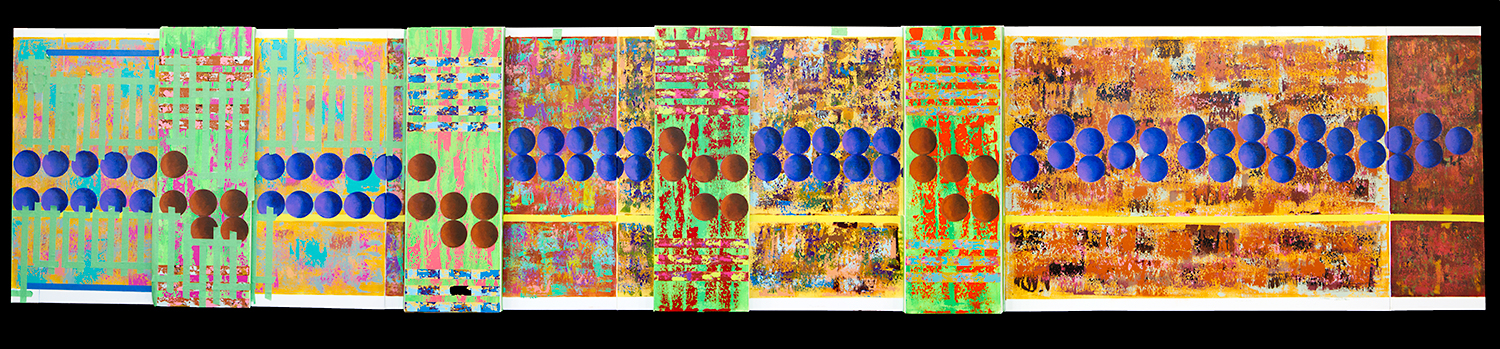

S_V_H Vivaldi’s Autumn allegro 3rd mvt. final image

Autumn3AllegroFinal

This is a studio final image of Vivaldi’s The Four Seasons Autumn Allegro.  This thirteen foot canvas has a busy and interesting look.  Usually, I spend multiple days cleaning, and touching up a painting, but strange this work took only needed a couple of days work to add the finish look. The most tedious part was the painting and finishing up of the words.  There was a lot of a’s and c’s that required an effort so that they appeared similar to each other. There was some concern about all the bluish notes, thinking maybe they where too cold looking, so I countered that with the browns on the four raised panels.  Since this is late autumn, at least where I live, it can get very cold, so the use of violet is a valid late fall color.  I then made an effort to put more late fall colors back into the work with the stems and the beams of the music. Some of the odd fall colors including the color green, are there to simply pop out parts of the work, and to add color interest.

Usually, I can just turn around and take a look at the finish work as I type, but I have already removed it from the easel, so that I could prep the canvases for the next Vivaldi which is Winter Allegro. My prepping of the canvases is applying three layers of gesso, and I have no other room but next to my easels to do this, so out the Autumn Vivaldi had to go to avoid splashing it with white paint. I am going to wire this artwork so that I can hang it in our living room, removing a favorite of mine Spring Danza Pastorale.

I spent two nights figuring out how to arrange the canvases, to best work with the music.  Finally, after multiple changes and verification of my math,  and the switching out of the far right canvas to a much smaller 30 by 24, to create a better balance, it is time to blot and screw all the pieces together.

Scott Von Holzen

S_V_H Vivaldi’s Autumn allegro 3rd mvt. image4

Autumn3Allegro4

You are looking at Vivaldi’s The Four Seasons Autumn Allegro the third movement image 4. You can see there is a lot of tape to better define the musical beams.  In the past I have spread different layers of colors across the beams, but since there is  already so much of that with the background I needed to create a space for the beams to better have them stand out. That is why you see the use of raw umber lightened.  I have to remember that this is a painting  for late fall, which means that most colors are earthy and faded.  Also, late fall is cold, and where I live there is a good chance of having snow on the ground. For my musical notes you can see and feel that cold in the use of light violet and dark purple. Still, this is autumn so I have other musical notes using variations of brown to counter the cool tones. As for the stems this is the first time I have built them of up with square pieces, and where I have also left them transparent, which modifies the texture of the background that is showing through.

If you look at the lower beams you will see that I have their base painted a darker shade of raw umber. The reason for this is that these lower beams solve the problem of where to put the words from the sonnet, and the darker color is better to have them stand out. Here is the third movement’s  part of the Autumn sonnet from H. C. Robbins Landon’s book Vivaldi Voice of the Baroque:
“The hunters at dawn go to the hunt,
With horns and guns and dogs they sally forth,
The beast flee, their trail is followed:

Already dismay’d and exhausted , from the great noise
Of guns and dogs, threaten’d with wounds,
They flee, languishing, and die, cowering.”

Not very uplifting, but it is late fall, and such words fit the mood of the time. Since I am not a hunter, and since I have room for only one line, the line that best fits me is the first about the hunters off to hunt. The Italian words are “I cacciator alla nov’ alba á caccia.”

That was the first difficult choice that lead to even a more difficult decision of were to place the words?  Since this musical part from the Four Seasons runs fairly flat across this 13 foot canvas,  I  decided to attach all the canvases together in a straight line ignoring the small amount of music flow changes.  Because of that I did not want to attach other canvases to add the words, for this would remove the evenness of this artwork’s look. The chosen line from the sonnet I could break apart into seven pieces.  Ignoring the four added canvases,  I counted seven  beams along the bottom. Painting them a darker shade of brown, gave me the background, and the space  to place the sonnet’s words.

One other thing that has changed my direction on this work is those two separate notes at the far right that end the movement. I decided to do the squares like the other stems, but I gave them different colors that match the cool feeling of the notes. These two notes are the break point of this music, and from them the music changes. I then took their square color treatment and have begun to apply those colors to the upper beams. These colorful squares add a certain mystery to the work, and leave questions not answered.

I still see a couple of weeks of work to finish this piece.

Scott Von Holzen

S_V_H Vivaldi’s Autumn allegro 3rd mvt. image3

Autumn3Allegro3

Vivaldi’s Autumn Allegro Mvt 3  third image. I am back to complete the 10th painting in the Four Seasons series. I must say I am tiring of this project, but of course, that changes nothing.  The need to meet the demands of each Vivaldi, plus my acknowledgement that each of these artworks must breath and grow through its entire life from planning,  construction, to completion,  no matter my emotional state, this is my job to complete. Thirteen artworks will make up The Four Seasons, and each new work begins where the last left off.  It is that simple.  It is a commitment.

On the left side of this work you are seeing the beginning of the extensive tapping, so that I can paint in a had edge on each of my stems. I forgot to photograph this artwork before I started the taping, and in a way I should have, but this blog is more a documentation tool, then a getting-out-the-message tool, so years from now I can look back, and see my style changes.

Looking back at my stem history, I can see that I shifted to the hard edge near the end of 2010.  In fact I see it on a painting that I have not looked at for a while, Every Time you Say Goodbye.  Before that I use to free draw the stems and  at times they looked good. The reason I moved away from the soft look,  was I wanted the stems to stand out more. In that way they became more apart of the flow of the music.  When painted in the stems, they really help my round head notes, by accentuating that part of the music. The stems are almost a counter to the notes, because they are vertical which depicts the flow as sharp points, that like the note heads, move up and down with the flow of the music.

My goal is to get this work done no later than January 19th.  The reason is I want to start the big one, which is Winter Allegro the first movement of the Four Seasons Winter Concerto. It was this music that began my passion for Vivaldi. Today, I have well over 19,000 pieces of music in my iTunes music library, but only two songs have a five start rating and Vivaldi’s Winter Allegro was the first.

Scott Von Holzen