S_V_H Have yourself a merry little Christmas image1

haveMerryChristmas_1Have Yourself a Merry Little Christmas is the  theme for this years Christmas painting. When completed I will then put together a Christmas card to be sent to those who purchased a painting from me.  Inside that card will be a small canvas print of Have yourself a merry little Christmas, signed and numbered.

This music was first introduce to the public by the beautiful 21-year-old Judy Garland in the 1944 movie Meet Me in St. Louis.

Here is an equally beautiful and talented Christina Aguilera along with Brian McKnight:

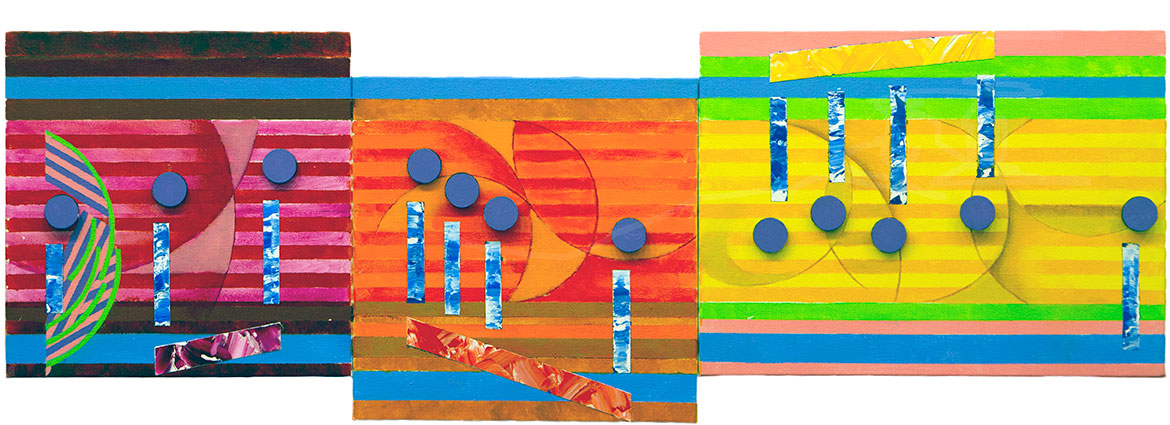
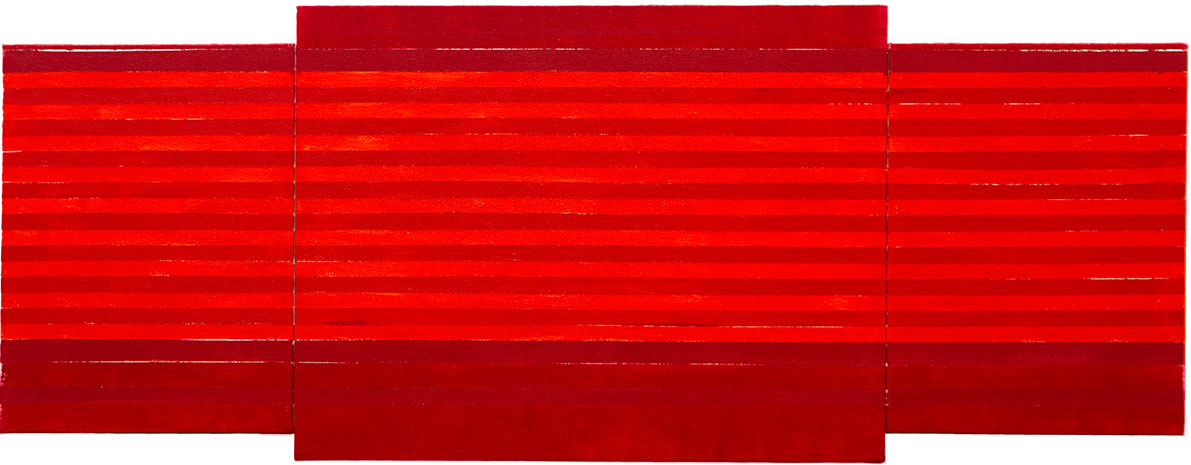
This first image show the finish of the basic background.  What I mean by basic is that this step is about putting down paint across the artwork, with the goal of covering up much of the white canvas.  Next up,  I will be taking what I learned in the last artwork, and  break up the horizontal striping using curved and straight shaded lines  This will add some interest to the background, and may even enhance the sense of movement of the music across the artwork.

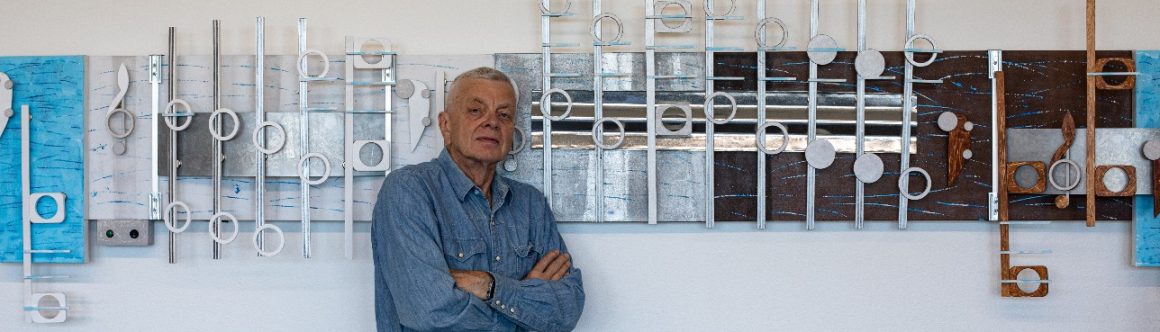
I have said this a in a number of my blog entries,  that a major goal of each of these paintings is to try to emulate the music the art is portraying. That is pretty hard to do with out sound. Previous efforts  by artists to depict music mostly as abstractions, I believe, have missed this point:  an artwork may be depicting a Mozart Sonata,  or it could as likely be a scenic image of a Kansas dust storm just before a thunderstorm.  For me musical art is not an abstraction, but something that is real, and that visually depicts each piece of music in a unique way that connects the art to the music.  All of these artworks work to represent that singular look, and  feel of that one piece of music.  The success of each of these artworks brings me closer to my goal of picturing music’s spontaneity, emotion, and uniqueness, in a static, and silent art form.

Scott Von Holzen
S_V_H Heaven’s Wall Final Image

heaven_Final

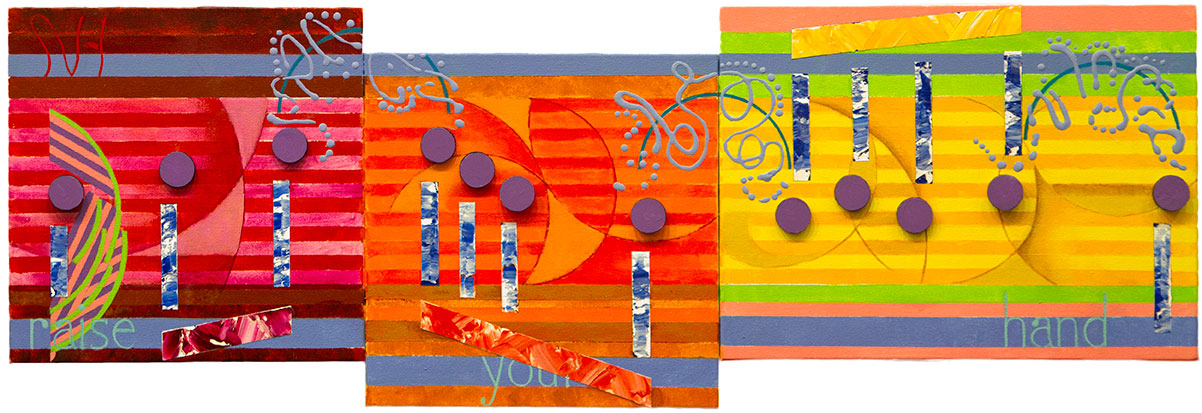
Heaven’s Wall is finished. This little work, only 40 inches in length, turned out to be an experimental artwork where I changed up my style.   One new change occurred in the background where I added curved lines on each panel. I then shaded along those lines to blend out some of the stripping. This accomplished three things:  added motion to the background, broke up the stripping (a more musical look), and finally created overall a large amount of added interest.   This I followed up with another exercise in drip painting.  Although I answered some questions, and accomplished what I wanted to,   I still do not have consistent control, or a comfortable feeling towards dripping.

That first flow note on the left I manage to create a different look based on an earlier work, Fine and Mellow.  I like the use of the colors pink and green around that note,  Those colors where also used in the far right panel, which helps to unite the three canvases.

Heaven’s Wall is my first artwork that has a feel for Gospel music, although I probably would not say that this is a Gospel piece, more Rock than church choir,  the music certainly is up lifting and the words do have a Gospel message.  The decision to paint Heaven’s Wall came easy.  I was out walking, and wondering what I was going to paint next, when this song played in my headset.  I ignored the fact I had recently finished another Bruce Springsteen artwork, The Ghost of Tom Joad,  maybe because the timing of the music fit the time I was in at that moment of choice.

Tomorrow,  I will embed a video about this finished painting in this blog.  In that video I could say something which inspired me to create this painting, but I will probably not.  At this point my only thoughts are I am glad the project is over,  lets clean up,  and put together the next  artwork, to see if I can do better.

I start each artwork with lots of enthusiasm, purpose, thought, and dedication.  When finished  all that euphoria that went into the painting has all emptied out, in what you see in it.   The finished work is then left alone on the easel, waiting its turn to be slowly moved about, from here to there, until it finally finds its self stack, losing its identity,  one among  all the others.

Scott Von Holzen

S_V_H Heaven’s Wall image 3

heaven_3This is the third image, of artwork of the music called Heaven’s wall.  The flow of the music is in place.  What is left to do is add three ties, the words, do clean up, and hopefully finish this painting tomorrow.  The final step is the clean up process in which I sharpen edges, touch of the paint, and add interest to those areas in the background to improve the contrast of the music and the background.

What else is new is that I worked on the three-dimensional look of the artwork, which is hard to see in the image above. I did spread the paint on thick for my beams and my shafts.  I also lifted the musical flow off the surface of the canvas at those spots where I will add the words.

This is not a complicated work, and not a large work, but what I keep discovering is that size means little in these painting.  I have this silly expectation that I can complete smaller works quicker, and in that way I can increase my production of artworks.  So far I have never seen that happen.  It takes about the same amount of effort, and time to produce each artwork no matter its physical size.    The larger works do need a little more paint, a little more time to spread that paint,  and more canvas,  but the materials, and way more important, the time to complete different size works I have found to be negligible.  Still,  because of common business practices,  my charge difference between  a large artwork that is six feet in length, in comparison to a three-foot painting, has always been considerably more. That makes obvious sense and is a good reason  that I should do larger paintings,  which give a greater return for my time spent.  In the past I have done larger painting, of course not for the return, but instead because painting big works is a lot more fun to do, and for their greater visual impact.  But that thinking, lately, has changed.

I still like painting large works,  but lately I have seen a dramatic increase in the cost of shipping of long objects.  This has made the pricing of many of my earlier larger artworks a lot more difficult. It is hard to balance what I think is my perceived value of a painting, and the final cost of that painting to the buyer.  Since most of my potential customers live hundreds to thousands of miles from me,  that extra cost does become a  consideration for doing smaller works.   Even a greater persuasion for me to produce smaller painting is the reality check that none of my customers, so far, have been collectors.

My current buyers are people who do not want an artwork to dominate an entire wall, like the art for the art itself, and have limited funds. What that means is that they want small works, to a point that even three-foot in length may be too long for their needs. This is all good for keeping my  shipping costs lower,  but it also does suppress my asking prices.

I understand this art has never been about money, but it would be nice to at least cover my time.   Going beyond that, the biggest advantage for painting smaller works may be the practical consideration that they will take up a lot less storage space.  That means I can stack more discounted priced artworks, instead of only a few large premium paintings, in my limited studio space.  Wow, that is a relief.
Here is a live version from a Bruce Springsteen concert in Perth in 2014:

Scott Von Holzen