
S_V_H Vivaldi’s Four Seasons Summer Presto image4 & 5

summerPresto4

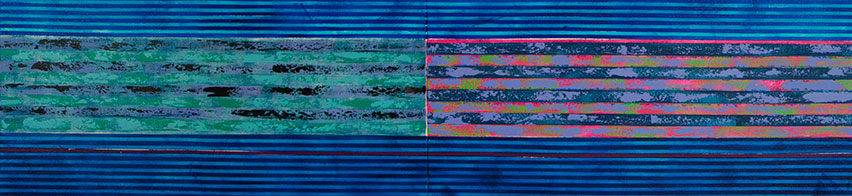
The Four Season’s Summer Presto sound and feel is that of pounding rain during a raging summer storm.  To capture some of the quickness,  excitement, and the sharply cutting sounds of this music  I am using the contrast of colors in light and dark shades.  By using all of the different elements of this music, hopefully this twenty foot artwork will eventually take on the look of a big bad storm on canvas.

Because the color blue seems a natural  for depicting  bad weather I have a range of contrasting shades to represent the flow of the music.  To introduce areas of brighter colors  I have turned to other musical elements in the music such as  the rests and the incidentals.  These smaller pieces from this music are minor, but besides filling spaces, they add lots of points of interest.

In the image above, a number of the rests are painted in red and green. A rest  pauses the music for an exact amount of time,  based on its style  Below, are two examples of rests, with the first pause being an 8th of one beat, followed by a 16th of a beat.
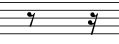
restsIn this painting the red lines, of a rest, have a stopping effect, while the green for the circles are the complementary color of red, creating a back-en-forth effect.  Besides the rests  the other objects that add interest are the sharp, flat, or neutral, which in musical terms are all incidentals. The sharp raises the pitch of a note a-half step, a flat does the opposite, and the last image is of a neutral which is the natural sound of the music.Accidentals
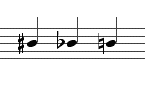
With the sharps. I first tried using a deep red for the legs, and a light magenta for the two arms.  It looked awful. Those bright colors, in between the blues of the music,  blocked the flow.  I  toned down the sharps by painting them a light blue, but then noticed that  the size of the sharps where too large in comparison to the the music. Since I had already framed in all sixteen sharps, which took considerable time, I needed to find  way to reduce their size without removing and redrawing them. My solution was to use darker shades of blue, to make one side of the sharp recede into the canvas. That help,  but in a serendipity moment, I removed a piece of tape that I was using to edge a color, and under the tape was a small strip of the original light blue color.  I knew then that by striping the sharps, and later the flats, would give them a unique look without conflicting with the flow of the music.  For the red and green rests they all appear before the music, and not in the flow, so I left them alone.

When I first started to put together my plan for this final painting of the Vivaldi Four Seasons series, I went back and looked at the twelve other paintings  and how each of them came up with their unique solutions.  My first thoughts about this last painting, was to do a composition that uses many of these different ideas from the past Four Seasons artworks.  I suppose, I thought it might be an easy way to start probably the most important artwork of the series.  But that idea soon was forgotten. I found, like  with so many starts in the past, I can borrow but not steal.

To explain, I have always looked at previous works to see what worked well with them, and what if anything that would help me with a step or two with new artwork. That actually does work, but only in minor ways, because certainly there are some common techniques that are shared between artworks, but because the subject, music, is so diverse I never end up following only one path on the way to complete a painting. With growing experience from producing these paintings I have learned that the best way to start a new artwork is to find the right amount of canvas for the music, pick a couple of colors that seem natural, play the music a lot,  and then make that first move to put paint on the white canvas. That is when a new affair between the music, the artwork, and me, all begins.

After painting many paths I finally reach that next special moment when I am seeing the true personally of the artwork coming to the surface of the canvas. It is seeing that special something on that canvas, that convinces me that a new artwork can be cool. It is like that first touch in a new relationship, when you go from smiles to a kiss.

summerPresto5

It has been a number of days since I started writing this blog entry. I have now made significant progress with Summer Presto, actually reaching the kissing stage.  I am confident I am seeing this works own unique identity coming into view.  It is a good feeling. A sense of finally understanding the direction this artwork wishes to go.  And the relief of knowing “I am good to go,”  and that soon there will begin, all over, the anticipation of what the next artwork will bring.

Scott Von Holzen

S_V_H Vivaldi’s Four Seasons Summer Presto image3

summerPresto_3This is the Last Vivaldi of the Four Seasons series. This is a large artwork 240 inches in length.

The following video featuring the soloist, Mari Silje Samuelsenh, displays her violin talent and the electric connection the orchestra has with this Vivaldi masterpiece from the start. Than, from the 24th second to the 34th of this movement, you hear the music that is this painting.  In only 10 seconds,  that takes 20 feet to represent, the entire orchestra does a number of synchronized head movements that is visually stunning.  Than interestingly just before the one minute and twenty seconds, the serious concentration you see in Mari’s face suddenly changes,  she smiles, letting some unknown viewer share her exhilaration in this, one of the finest performances of  any music,  composed almost 300 years ago.  Amazing.

My challenge is to do some of my head bobbing and find the way to paint the emotions of this music into this artwork.

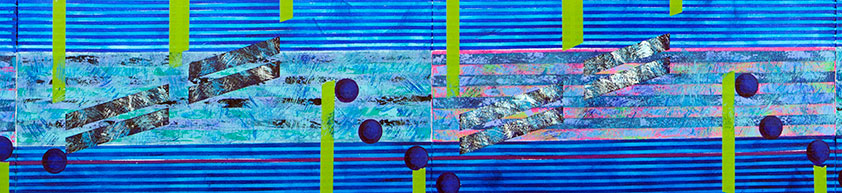
The green strips, you see on this work in progress, are pieces of removable tape I use as a guide and to create sharp edges for the painting of the this music’s shafts. You can see by looking at the flow of the music going up the scale why everyone shakes their heads.  That up and down is a natural movement with the music.

I would like to mention that you are seeing a small directional change in style. If you compare the middle stripping from the first image of this work, with the second image, you will see that I have done something different from earlier works.

This close up of image one is how I have portrayed stripping in the past: using multiple layers of colors spread all within a single strip:

SummerPresto3CNow, with this second image you see I have added, using different colors, brush strokes in a cross hatching method, that covers multiple strips. This helps to create a less stagnate and more interesting image, without losing the structure of the artwork. This is a small part of that head shaking I need to represent.

SummerPresto3D

Finally, a little reflection:  I have looked at a lot of music representations in art and the best of these works are pure abstractions. Although at first that might be thought of as the logical method to display sound,  I do not see it that way. I do not paint music as an abstract. Instead I show the structure and organization of music, while always remembering that a piece of music is never played the same twice. This artwork strives to represent the spontaneity, and diversity of music, and not the cookie cutter images you see in sheet music. This art flows with the music, but is never meant to be precise. This art displays, in tribute, the beauty and wonder of a single musical piece.

Scott Von Holzen


S_V_H A Great Big Sled Christmas 2014 final image

aGreatBigSledFinal

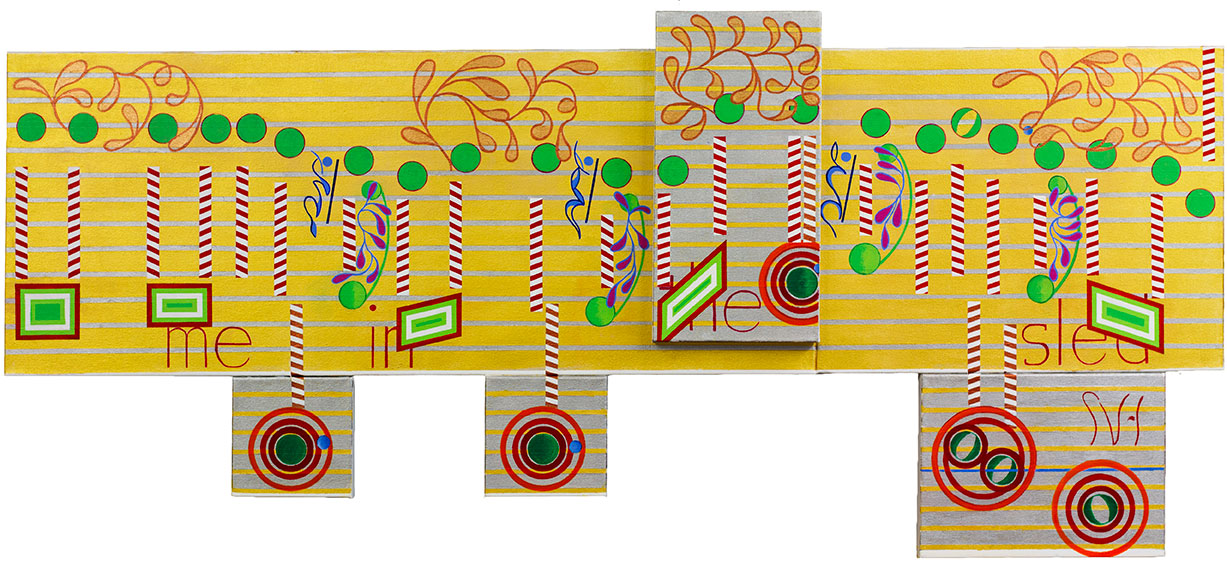
A Great Big Sled Final Image. Here is another version of this wonderful Christmas song with a modern edge to it. When you hear those bells, you are listening to this artwork.

This finished  artwork uses six canvas panels with a finished length of sixty inches. Any picture of this artwork will never compare with seeing it in person. No image I can produce captures the look of the gold and silver paint that dominates this work. This resulted in a long struggle to produce a decent canvas image for this years Christmas cards.  Finally, under the press of mailing dates, and the conclusion that I could not produce a match of the work, I did my best to print something. This years Christmas card printing is largest ever with thirty copies.

Looking at the overall finished artwork I like the look of the candy cane stems. They were a lot of work,  not tedious, but time-consuming.  I especially like the look of those long blue objects that are my version of musical Rests. I painted over a dozen Rests, each different from the last, in the last Vivaldi. You can see that look being carried over in this artwork. What I am seeing in my Rests, is a good solution in design that has quickly become a mature style. The Rests will certainly evolve over time, but not out of need or necessity.

My symbols for the bell sounds, surrounded by extra circles, are nothing special, but they work, filling space while adding interest, and the opportunity to add extra canvases to make the look of this artwork, unique. My musical vine looking Slurs, you see all across the top of the canvases, and repeated in a red color in the music, give a Christmas look to the work, and fill space while pushing the music across the canvas. My red and green rectangles I like for their sharp edges counter the rounded forms of the slurs and the other rounded objects in the music. My choice of words where the best option, that balance well, and flow nicely across the painting. Still, If I would have had another choice I would have left out the word ‘me.’  I like words to connect personally to the viewer,  leaving me out of the picture, but this did not work.

As this art has taught me over the years, I have come to respect the limitations when producing each painting.  Each of these finished artworks are a display of an abstract idea that is music, and the price of admission that allows me to paint another. I always hope that my next artwork will somehow solve the disappointments with the last painting, but I know that Music is a vastly diverse language, so that challenge is great.  I have to constantly look at my art and question how I paint, and if I can find another, better way, to visualize sound that a viewer can relate to.  This makes everything complicated because for this art to evolve artistically, I have to keep an open mind, with all of its options, no matter the direction this may turn me.  It is that search to find new ways to apply the colors of acrylic paint to pieces of canvas, that will forever remain the goal. This years Christmas painting breaks no new ground, solves no problems, and answers nothing. That is what I expect from the last artwork of the year. Instead, in all of its non answer glory,  It is a summary of this art’s 2014 style that leaves open another opportunity for improvement. On to 2015 where the best artwork is yet to be built.

Scott Von Holzen