S_V_H Your Foolish Heart 2nd Image

My Foolish Heart on a 24 x 30 inch canvas.

For each new project, I plan out what notes from the cover music I will mount on the artwork. Since there are not a lot of notes in this sample, I made the mistake of making them larger. The size of my circles went from my recent standard of 1 5/8 to 2 1/8 in diameter. Increasing the size of the notes also increases the width of the music. What I found was that on both the top staff and the middle staff, there was not enough space to hang the song notes. When this happens, I would let the music hang over the edges of the canvas to add more interest. But for this project, I had too many single notes that prevented a simple fix.

The other option would be to add another canvas to make a fourth metal staff support. Rejecting that idea, I found a different solution. Below is an image of the earlier 2026 artwork, Drive. This project uses my standard three 24-inch metal supports mounted in a straight line, similar to traditional musical staffs. With My Foolish Heart error, I decided that my notation no longer needed to be mounted in a straight line.

In later 2026 artworks, I experimented with an uneven mounting of the music, mostly for special effects. The image below, From the Start, is an example where I created a step effect for the single repeated word, “blah, blah, blah.” To solve the mounting issues with this project, I zig-zagged all three of the support metal staffs using different lengths of standard metal pieces from Menards, thereby making the staffs longer and easier to mount the music. This eliminates one of the last sacred standard features of sheet music.

My staff guides arrangement for Foolish
Drive from earlier this year showing the standard staff setup (seen in the notation cutouts) of 3 straight metal staff supports that match the width of the canvas.
From the Start 2026

Scott Von Holzen

S_V_H’s Interactive Constructive Sculpture

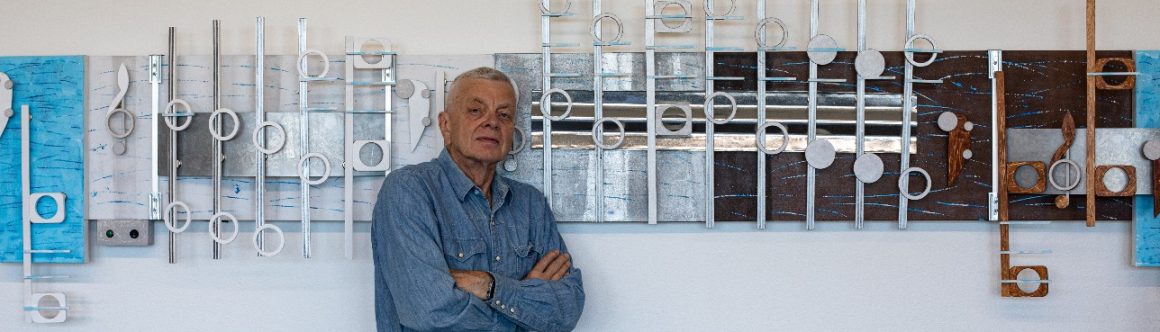
1st image of the artwork’s construction: The artist in his Wisconsin red hat, echoing the artwork’s equally strong use of red.

I have this instrumental by Bill Evans, an interesting jazz pianist, stored in my Favorite Songs playlist on Apple Music, but until now I never thought about painting it. This music caught my attention at the right time, while Iwas looking for a new project. My mood is for a lighter song, involving only a basic three-person jazz melody comprising piano, bass, and simple background use of drums. What stood in this Evans cover of My Foolish Heart is the stand-up bass accompanimen, and these lyrics: “When you’re lost in the magic of a kiss. Her lips are much too close to mine. Beware, my foolish heart”

The beginning of a new project involves several first steps, including creating a worksheet to make sure the “sampled” music fits on the canvas. In this first image there are three prominent adjustable metal strips. The worksheet therefore has three staves. When working on the artwork I will use us my own custom notation and this worksheet to build and attach the notes from my cover sheet music onto those three arrangeable metal pieces.

Bill Evans live playing My Foolish Heart 1964
Billy Eckstine’s 1950 My Foolish heart, “.. version became a million-seller, spending 19 weeks on the charts and peaking at number 6.” Wikipedia

Of interest, and for a better feel of the music, I search for live video versions of this song. I also read up on the song’s history, noticing that it was Billy Eckstine’s version of My Foolish Heart that became a popular hit. I doubt I would have chosen this music based on this original 1950s version so at first, excluded this audio from the post. My thinking was I did not want the reader to think an old guy doing an old song. Bill Evans’ jazz cover is how I came to know this song. Later I realized an interesting take on the Evans and Eckstine versions. The sheet music did not change between the two songs. The lyrics didn’t change. But fourteen years separate the Eckstine and Evans recordings, and that timeline I now see as a difference in the music’s “style”. The music never changed; what changed was its presentation. Amazingly, that it is now 62 years after Bill Evans’ versions. And now the same idea of changing the style, not the music, is happening again..

Early Worksheet for the Artwork My foolish Heart.

A little aside and then back to the artwork.
I have often wondered if I could step outside myself. Here is a little top off my cup of coffee before going back to work.
My posting time has not kept up with my work in progress. That is because I was spending weeks of my time on one important art submission, and a backup. I had enough 2026 works to submit to the ARC Gallery in Chicago, but I wanted to add two fresh artworks. This turned out to be challenging and time-consuming. This art, no matter the needs, continues to develop. And when it does, this requires a lot of trial-and-error adjustments, timeline be damn. The results where I barely finished each of them to only be just enough to submit on their last deadline dates. Unexpectedly, both submissions received a friendly, generic rejection.

I know well “rejections” over the years. This time felt different. I thought all the effort with these two recent works, especially the one titled Rolling in the Deep, would present enough interest to make the first cut at the ARC Gallery. I also felt that of the two latest works, one would be a solid choice for the local Pablo Annunal exhibit. This thinking comes from previous rejections by The ARC Gallery, allowing me to improve on my submissions. As for the Pablo I have shown there twice over the years, with 2021 and Play That Song being my last. I knew well that the exhibition is a crap-shoot because the jurors change every year, meaning every year is a simply reset, no matter the quality of the art.

That got me wondering if I stepped outside myself, could I see this art objectively with the same eye as the artist? What would I think of his wall hanging interactive, constructive sculpture wall art? I believe I would be curious enough to at least think, “Who is this guy, and what is he up to? “ In over twenty years of putting this art out there, “connecting” to people and walls has been temporary at best, and missing at most. I put these thoughts here because they are part of where I am right now with this art. And even though they have little to do with today’s art direction, the past has everything to do with this present project.

Here are a couple of earrlier versions of this artwork showing my build of the stereo system that will be added, inbetween the two side-firing speakers.

I have a 24 inch wide by 30 high canvas for My Foolish Heart with that comes in with a current depth of ≈7 inches in.
This is the latest version of my Essential artworks stereo system setup that now includes a standard 5.5 inch subwoofer.

Here are of couple of live videos of My Foolish Heart along with this interesting audio of a favorite singer of mine and working with Bill Evans.

My foolish heart audio form the 1975 Tony Bennett Bill Evans album.

John Scofield (2010) live My Foolish Heart.

Dianne Reeves a great singer that fits with Sarah Vaughn and Elle Fitzgerald, but a voice that can be heard.

Antoine Boyer. He recently recorded this video of My Foolish Heart in 2025.

Mr. Brightside is the assistant editor, along with the software ProWritingAid. The author remains responsible for the final version.
“No AI-generated or AI-altered imagery; photographs are camera-captured by Scott Von Holzen.” 08/25

Scott Von Holzen

S_V_H Love Theme (Cinema Paradiso) final

Studio Image
Love Theme (Cinema Paradiso)
≈ L41.5″x H35.5″x D6.5″

The title of this latest music box is “Love Theme.” The Upper canvas mounts this artwork onto the wall. Written in cursive Italian across the upper canvas are letters and words deliberately made difficult to recognize. Those words are from the artwork’s cover music. The lower larger canvas than hangs from the smaller canvas using a coated wire. Using cursive writing, the repeating flow of words written on the main canvas represents the lyrics that the artwork is sampling. Rising above the canvas, held onto the artwork with magnets, is the artist’s own form of notation. Its up and down flow represents the melody of the words written on the canvas. This artwork exists to present to a viewer a short cover music of a great song. A song that stands out in its use of melody, harmony, and lyrics if you understand Italian.

A reflection about this art and the music box, Love Theme.

Scott Von Holzen

The artist’s cover music for the music box, Love Theme.

I should explain that on my website scottvonholzen.com and on my Portfolio for EmptyWallsArt, I edit down my cover music to 30 seconds. Both sites I define as commercial websites and to meet (any ones guess) copyright rules I provide only a sample of the artworks music. But, this .org site purely exists to tell and document the story of this art. That is its sole purpose that began with the first post in early 2010, onward. And since there is between nothing and near zero public interest in this story, I am going to put it all out there in the details of this art and in my words. Just in case someday this art finds its light.

If I would offend the owners of the music on my .org site, of course I will comply. It is not my music. I did not write it. And yet this art is solely mine. It states clearly my passion for great music. As an art I have always defined it as creating a portrait of a song. Maybe over many years from now, a viewer will find one of these artworks, and by some miracle he or she will press the green button and the music will play. And they, as I do each time I listen, maybe feel the same sensation as I do: “Wow, that was good.” And therefore a song, maybe long forgotten, will again be a harmonic curiosity for a new generation of music appreciators. A piece of music that rings in their heads. This art will reach forward because this art presents itself to the listener in multiple ways.

The artist’s choice of music begins as always, with his attention to three major give-and-take components of a song: melody, harmony, and lyrics. These three features awaken this artist’s interest in a piece of music. But other features of music, such as rhythm, originality, emotional impact, the story of the music, or the story of the artist who created the music, provide additional support. If everything adds up, I can then justify my time, money and effort. That is all there is to it. Unlike 100 percent of artists around me (I have never met another me), this art is not about money. This art has always been about the music, and using my time, my money, and my effort to continue what was so in 2006 still is in 2024.

Scott Von Holzen